
Filed under: Uncategorized

Richard Verner Green, MS, CHMM
Juxtaposition-part-I
I love chemistry. Even before learning what a “chemical” was, something about stuff fascinated me, and my father provided some really cool stuff while raising me in both the tropical, watery paradise surrounding Miami, Florida, and every summer I can remember, high up in the cold, dry, majestic Teton Mountains of Jackson Hole, Wyoming; for me, the old DuPont commercial was prophetic, better living through chemistry. –see endnotes 01=chemical properties







2-10
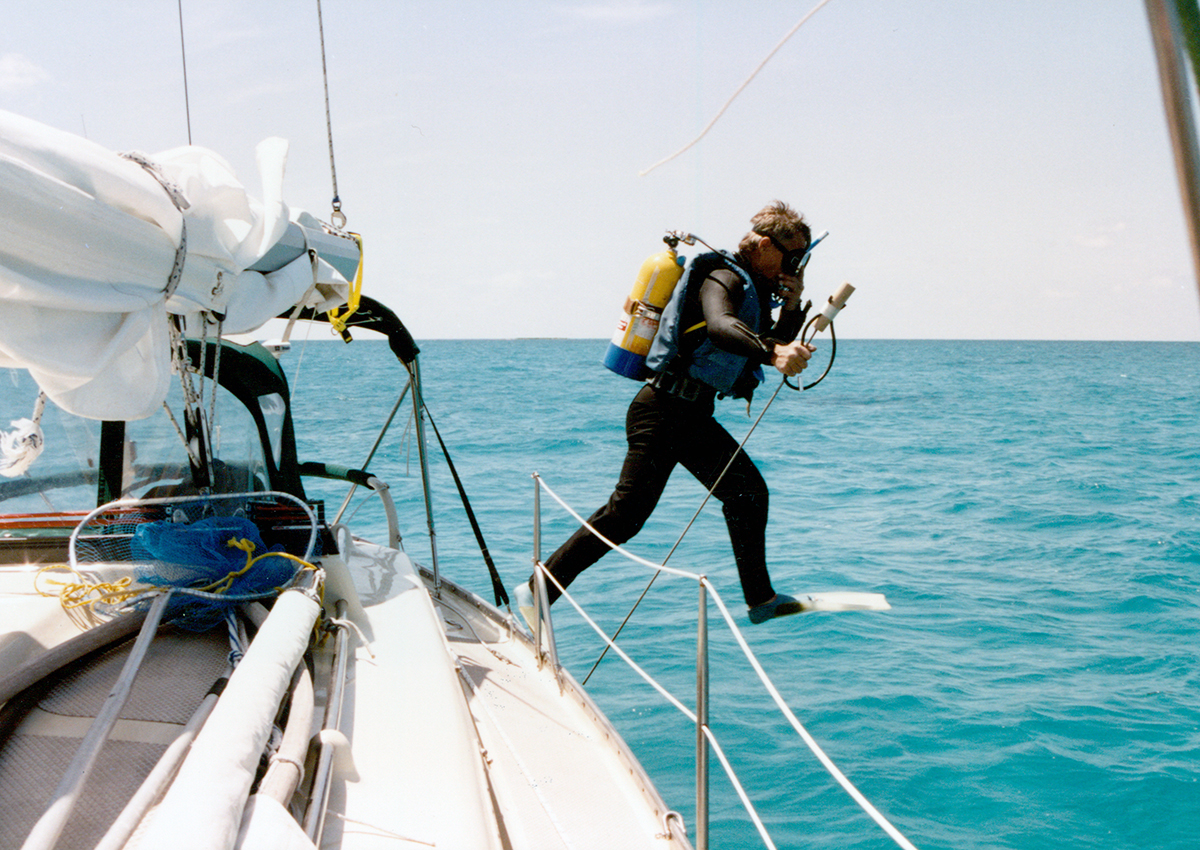
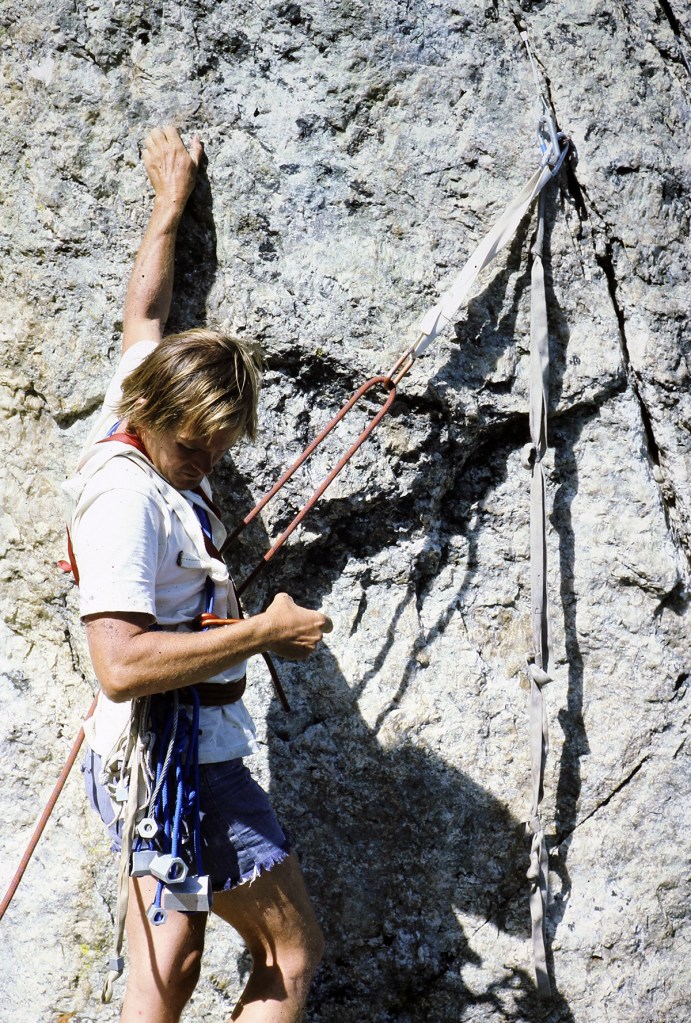
Through chemistry and the invention(?) of new man-made chemicals such as nylon, kevlar, gore tex, aluminum#02, and stainless steel, we had access to tools and equipment unimaginable only a century ago (or before Dmitri Mendeleev‘s first 1869 Periodic Table of the Elements- instructions for making chemicals). These new materials allowed innovators such as Mr Jacques Cousteau (scuba diving and spearfishing equipment), and Mr Yvon Chouinard (Mountaineering equipment and the founder of Patagonia) to create incredible, even miraculous, new stuff, which not only allowed us to live better, but migrate between magical worlds on paved #03 interstate highways with abundant fueling stations in only two days, rather than the many months it took, not long ago, when horsepower came from actual horses.




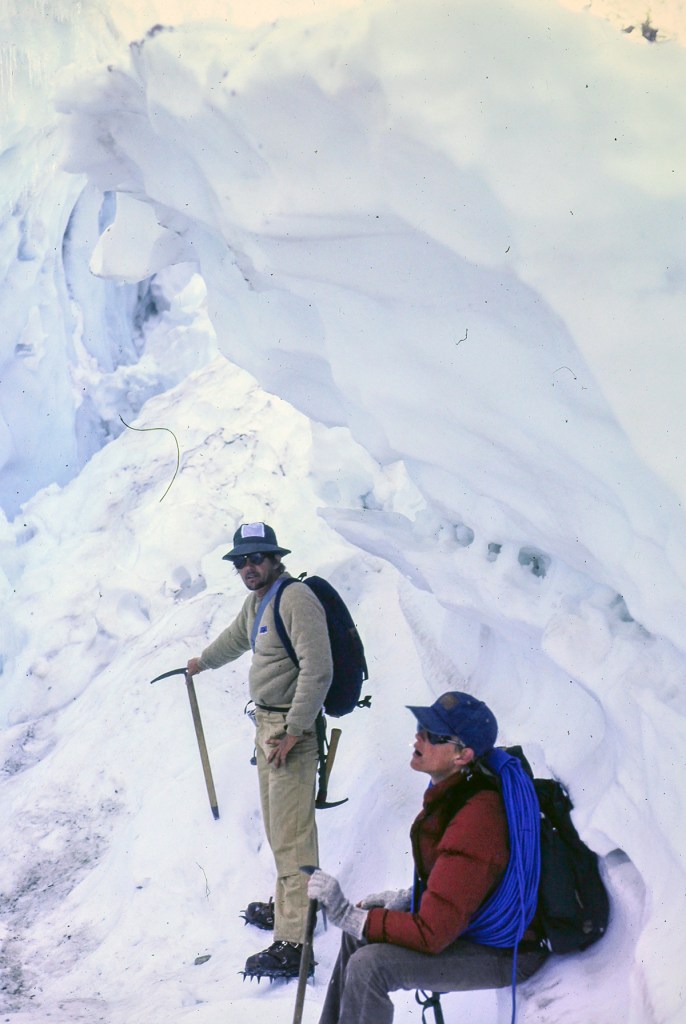

11-18

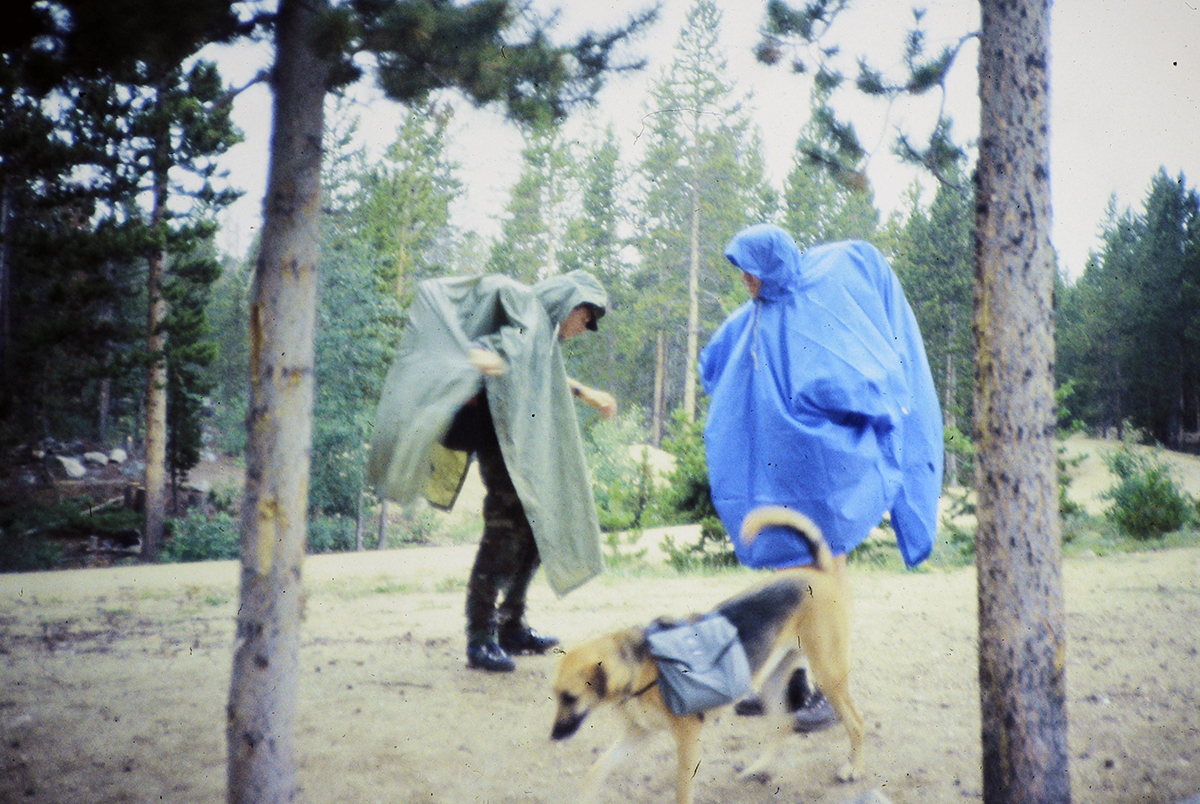
19-20
DIY Chemistry; Do It Yourself with Chemicals.
Chemistry not only gave us all the right stuff, but allowed to build our own cool stuff (today, YouTube is a treasure trove of awe-inspiring DIY videos). In 1978, along with my new step mother-pic19, we began (re)building Manatee, a 34 foot wooden sailboat made of oak, teak, mahogany, and pine(most store bought lumber is pine)pic19-22; in 1980 we began building Rainbow’s Shadow, a 45-foot fiberglass sailboat–pic23-26 made entirely of man-made materials (until recently, wood has been the only material which could be used for building boats), and our collapsible catamaran–pic27-28 made for searching through(and sometimes climbing over) the vast network of mangrove islands bearding the southern tip of Florida for signs of the rare and elusive saltwater crocodile for Everglades National Park.



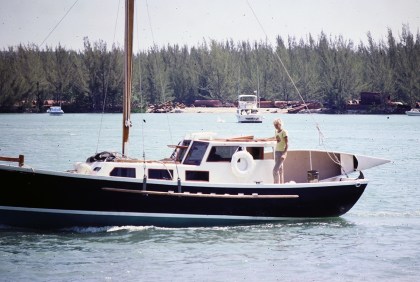
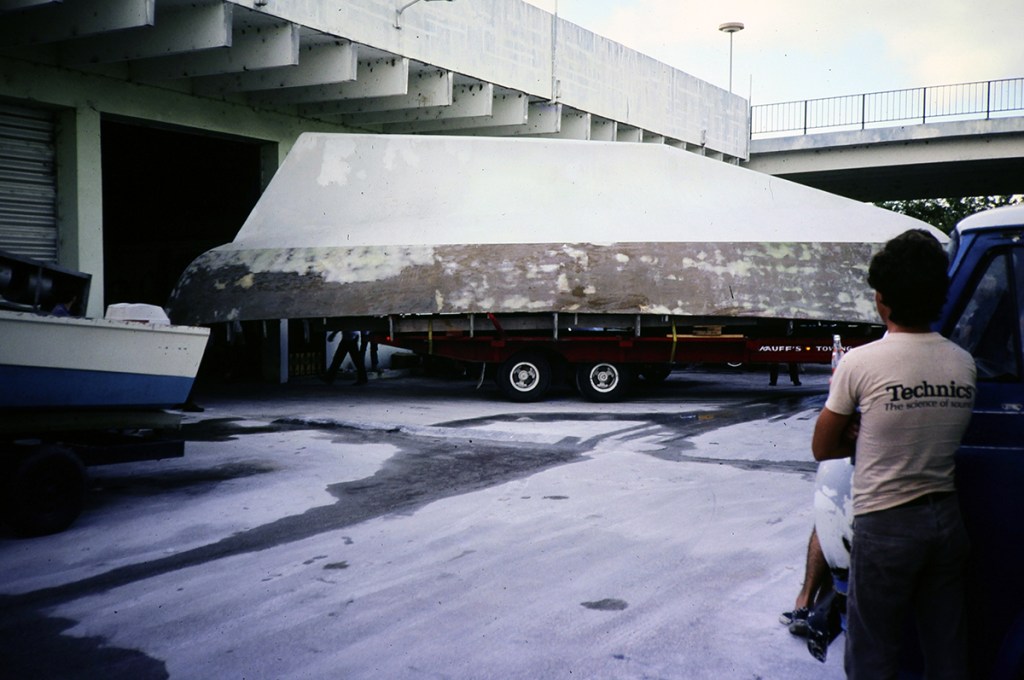
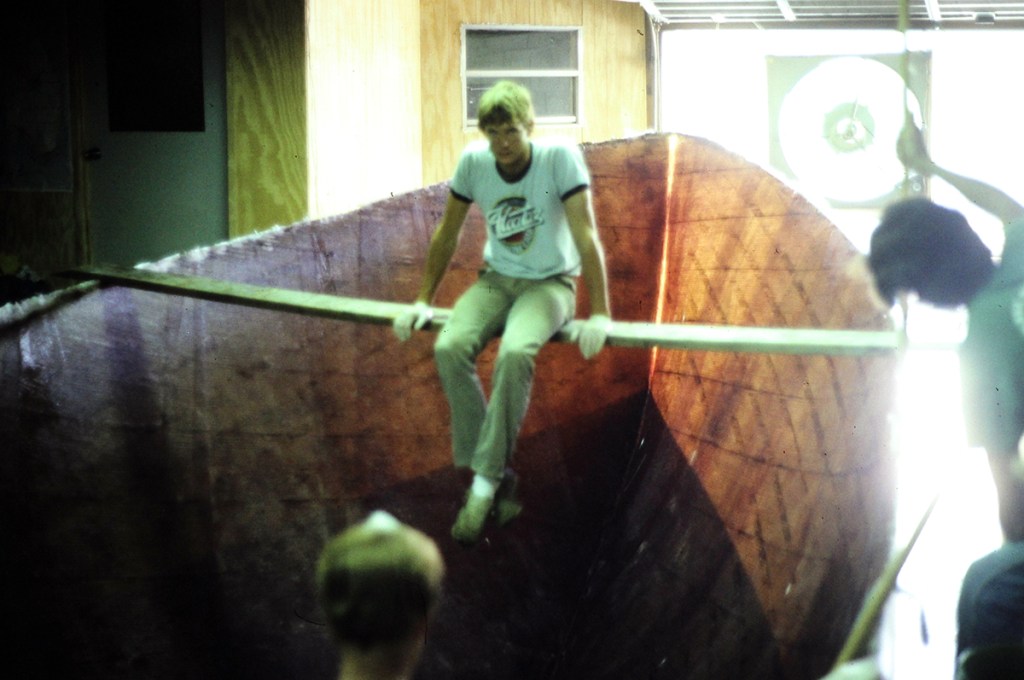





21-32
All the stuff we needed for building boats (or anything else) was available at the local hardware store, and while there are lots of those in Miami*, my favorite was Sailor Man in Fort Lauderdale, Florida, where I loved getting lost wandering around in all of their mesmerizing stuff, from barrels full of copper nails and stainless steel screws (purchased by the pound04meas ), to the latest in electronics: global positioning systems, satellite weather, and ‘fish finders’, as well as, a huge array of second hand, or reusable stuff such as an antique brass ship’s bell for Manatee, or a giant stainless steel and teak steering wheel for Rainbow’s Shadowpic33, ,or aluminum bulkhead hatches with spinning wheel locks (like a submarine) to help protect Rainbow’s Shadow from sinking during a storm, safety equipment save lives, and would later on in 20–: see story of RS-#05-)
*all of South Florida is “Miami” to me thanks to paved roads, paved boat launching ramps (pavement in the water), and abundant (boat) fueling stations which gave us easy access to all of South Florida from the Everglades, to the Keys, the beaches, the Inter Coastal Waterway, and even the Caribbean Islands and Bimini’s concrete wreck, an amazing artificial reef, and my favorite place for seafood pic 6
Grand Teton National Park (GTNP)
During the summer, my (other) favorite store was Teton Mountaineering in Jackson Hole, Wyoming. Teton Mpountaineering (TM), not only had all the latest stuff for the relatively new “sport” of mountaineering, but that stuff was evolving at an incredible rate, right before my eyes, thanks to chemistry. T.M. opened in 1971, and became our first stop in the ‘city’ of Jackson (Hole), to see the latest new tools and equipment which made mountaineering possible from climbing: boots, to 300 foot nylon climbing ropes, aluminum carabiners (for connecting to the rope), and aluminum ice axes, crampons and climbing anchors: climbing protection,.
My father bought me my first pair of climbing boots at TM, the Pravada-5 by Vask pic15 made of thick leather uppers with steel shanks inserted into the “rubber”#03 soles, to make them extra stiff, like ski boots, to support the ankles on hard, unforgiving rock- nothing like Miami’s soft, warm, beach sand where we often went barefoot; there is no going barefoot in the mountains. Human feet are delicate need the protection, as well as the insulation to prevent Body Heat from draining away into the cold rock. In the old days, insulation came primarily from natural, or nature-made chemicals such as leather, wool, animal furs,, goose down, and cotton and linen (flax).
The on;y problem with natural materials is they are not waterproof, and water(or any other liquid) seeps through, and soaks (saturates) the material#06, and in the lethal cold of the Tetons, getting wet can be fatal (hypothermia), whereas. In Miami, it (almost) never gets cold, and is (almost) always wet, even the air gets wet, or muggy #07humid. In the late sixties and early seventies we carried separate rain gear and cold weather gear (Panchos pic20) as our cold weather gear could not be allowed to get wet or it stopped providing the needed insulation. We also had to treat our leather boots with a product called Sno-Seal (basically purified#08 sno-seal . beeswax), to make them waterproof, at least temporarily, depending on how well (carefully) we treated them; like painting wood many small coats work better than one gig sloppu coaats
By the end of the 1970s , through chemistry, and T.M., we had kevlar climbing boots (lighter, stronger, and completely waterproof), gore-tex down jackets and gore-tex down sleeping bags (the Mummy, by Marmot, waterproof and rated to 40 degrees below zero), along with titanium climbing anchors*, and my own, personal, aluminum carabiners with the word ‘Chouinard’ embossed across the side, and always looking up at me while rappelling down some mountain cliff pic13, as easily as scuba diving down some ocean reef breathing underwater(thanks to Mr Cousteau ); better living
*boat anchors have to be big and heavy to work properly have to be small and light pic14, similarly, backpacks evolved from canvas, external frame packspic19, to nylon, internal aluminum frame packs
In 1978, after years (summers) of exploring the Tetons using the new ‘tools of the trade’ for exploring the mountiains,pic22-23 and his Emergency Medical Training(EMT), my father was hired at Grand Teton National Park as a seasonal climbing ranger on the park’s mountain Search and Rescue team(SAR)* pic23-25. During the summers of 1978 and 1979 we lived in an idyllic little log cabin on cottonwood creek with the Tetons sitting in our backyard(Teewinot)-pic22, and all the hot water and fishing I could want. Where before we slept on the ground in nylon tents, with foam (and later inflatable plastic) pads, and hot showers were a rare and expensive commodity, which we had to pay for by the minute, with lots of quarters, way over at the Colter Bay campground.
With Cottonwood Creek winding right past out our back door, getting wet while fishing was more of a nuisance, than a hazard, whereas in Miami, getting wet was required for spearfishing and lobstering ( towing along behind our boat looking for the tentacles of lobsters sticking out from under rocks or coral heads (or shipwrecks pic00), In either place, thanks to chemistry and refrigeration with freezers and home-made ice, we ate like kings. Pic18……SAR:accidents happen, but being prepared for accidents prevents them from becoming disasters, like having a fire extinguisher when you need one, or a rescue squad, or a fire department t or police when you need them: “time and chance happeneth to them all’, Ecc9:11…(9-11?)
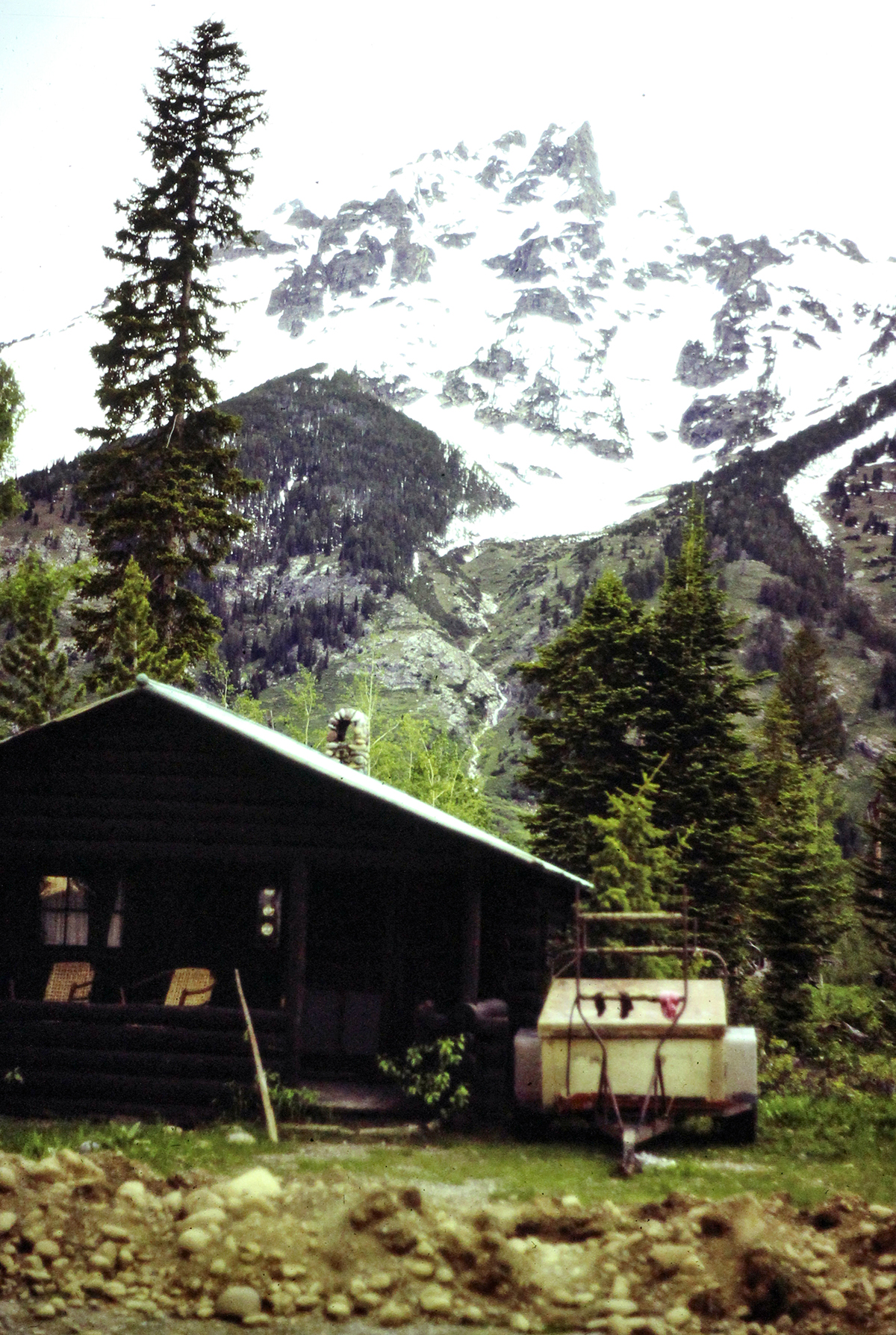


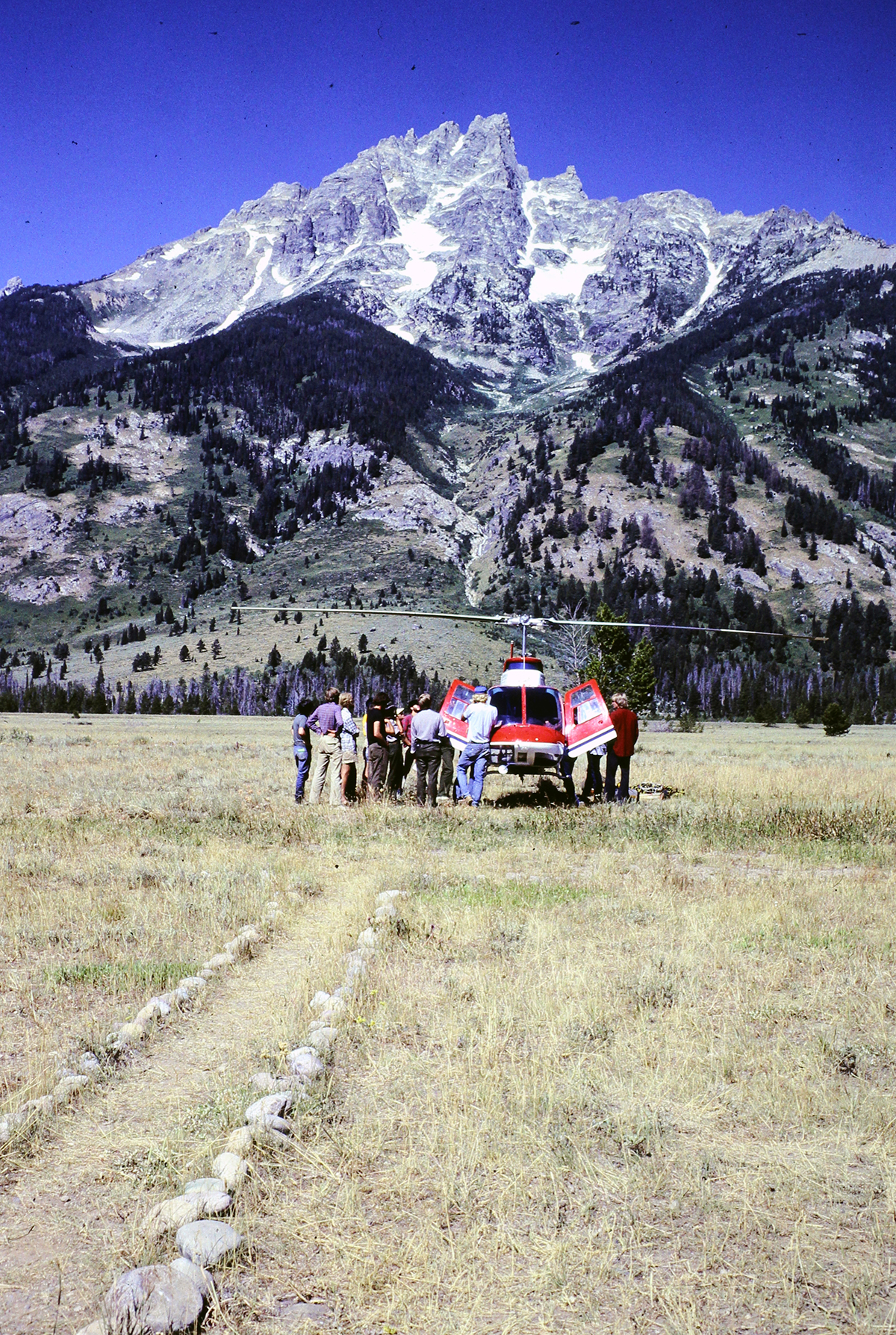
- pic 32 my father’s climbing partner, who together, climbed a new variation of a route up the north face of the Grand Teton (the other reason my father got the job)
Chemical Safety: Risk versus Benefit
By the time I got to high school, I was ready to learn more about stuff, and a great chemistry teacher was able to guide us through the maze of technicalities which loses so many people in details; lost in the forest for the trees. Chemistry, and understanding chemicals, is like a hole where the deeper you dig, the deeper it gets; wood is not just “wood” to a carpenter. Fortunately, in the same way it does not take a mechanic to drive a car, it does not take a chemist to use chemicals both productively and creatively which my parents taught me building sailboats; like driving a car, the first rule of chemistry is safety; you can always get more chemicals, but some chemicals, particularly man-made chemicals, are dangerous, even deadly, when not used properly: “No Smoking” is not a suggestion (Arrive Alive!).
The ‘rules of the road’ for chemical safety were summarized by the US Department of Transportation(the DOT- 49 CFR) back during WW-II in order to ensure the safe (as possible*) transport of chemicals all over the country, and today, all over the world (to a store near you). This system is based on the KISS principle: keep it simple stupid, (because) first responders at traffic accidents do not have time for a chemistry class: they need to know what they are dealing with, and how to deal with it… safely,
This lead to the creation of the nine hazard classes pic38, to categorize all chemicals into a few easy to recognize, and deal with groips, along with and the universally recognized symbols or each, like the skull and crossbones for poisons, or the radioactive cross, with the four most critical properties, the NFPA-4 pic42 being flammable, corrosive, reactive; and radioactive-

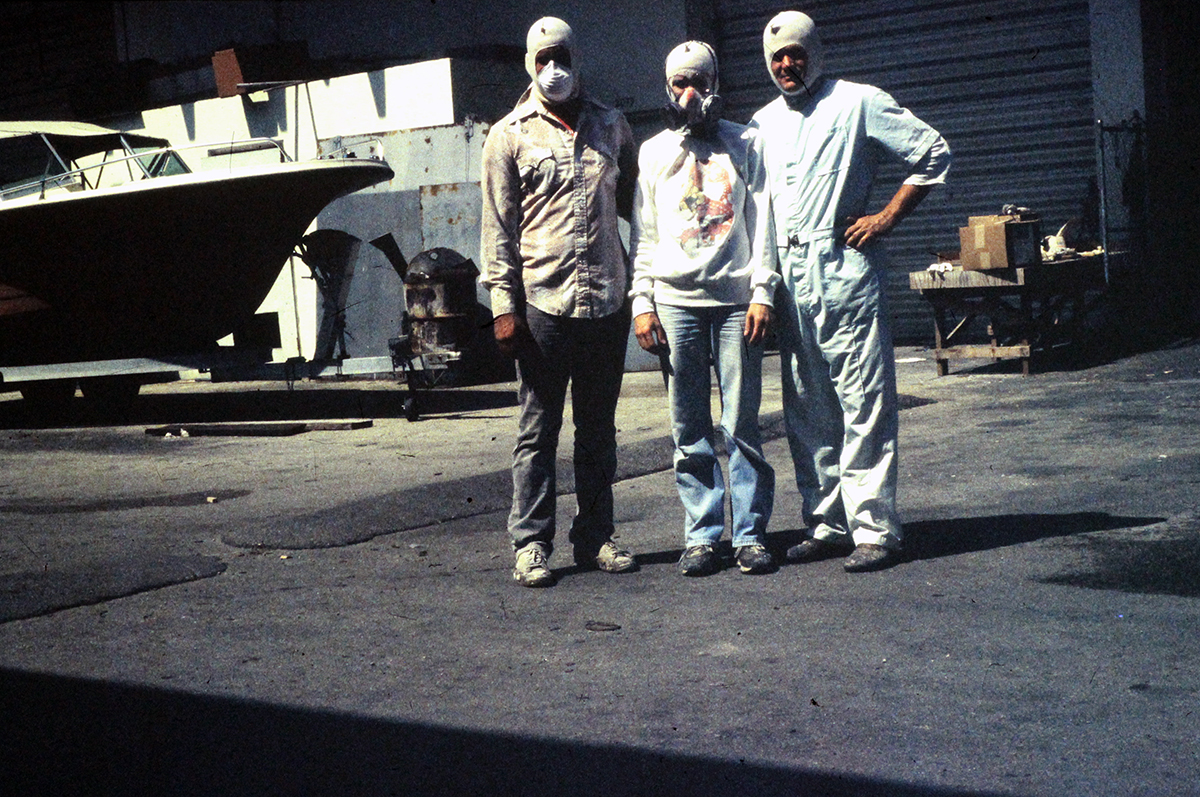




40-47
It was chemistry (class) which ignited my interest in school, giving us students the chance to use new (to us) tools and equipment which allowed us to ‘see’ (observe and measure) some of the amazing properties of chemicals; properties which allowed the creation of miraculous stuff: scuba diving and mountaineering equipment, to smart phones, GPS, reusable rocket ships, biofuels*, and telescopes which can “see” planets orbiting distant stars. (*see Biofuelsdigest.com)
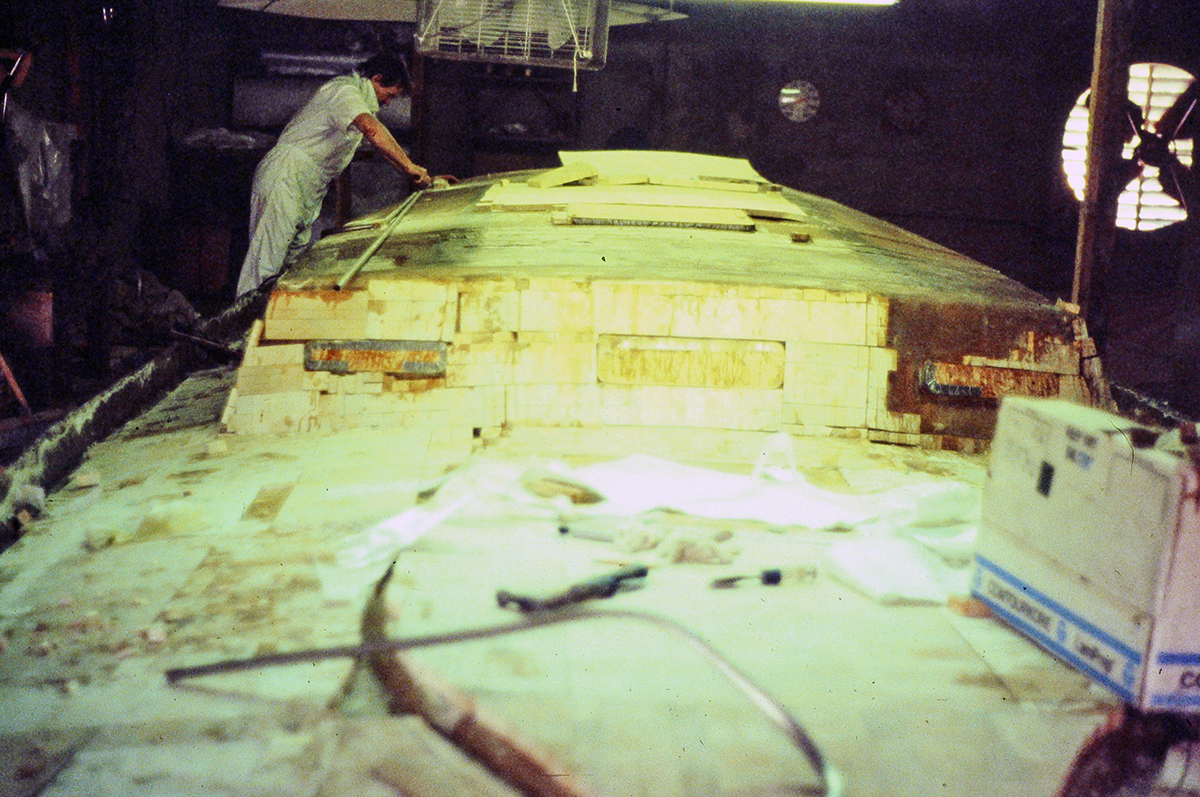
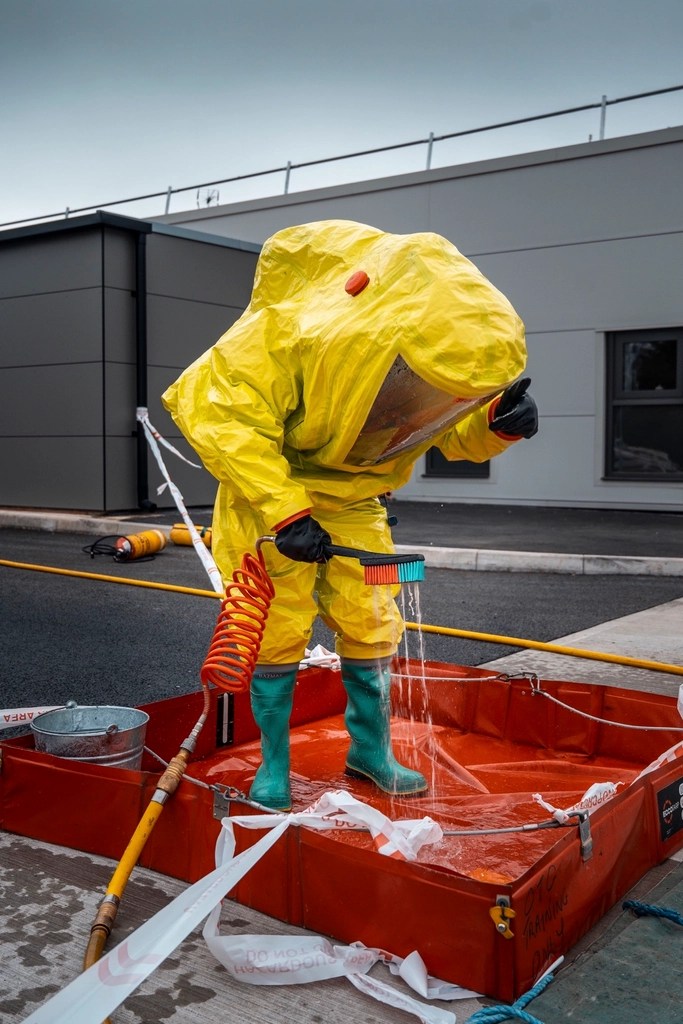
The benefits of chemicals are only limited by our imagination, but the risks, or hazards’ of chemicals are easily eliminated with the proper management: as our teacher was constantly reminding us before starting labs using chemicals “wear your PPE”( personal protective equipment, like itrile, or latex gloves, and polycarbonate safety glasses- splashes happen); and “close the lid” because properly contained chemicals do not spill and are not hazardous: leakproof, air tight containers made of the appropriate material- (see LUSTs below); and treat chemicals like dog feces: don’t smell it, or touch it without PPE, never don’t taste it(getting it in your body: through inhalation, ingestion, absorption through the skin, or injection), and don’t spread the chemicals’ residues around,(like stepping in dog feces) and if you get any on you(or might have) wash it off with soap and water as quickly as possible (see pic44 decontamination pool). Chemicals are best kept in areas prepared for chemical use like a laboratory, or factory, warehouse-pic00, or ‘out in the garage’.#00 areas with fire extinguishers, sand or other absorbent material like paper towels, PPE, and fans to blow out fumes from volatile chemicals like oil based paint or solvent
Unfortunately, many man-made chemicals are much more dangerous than dog feces, as they are practically invisible (colorless and odorless), or harmful in amounts (concentrations) too small to notice without instrumentation, like radon gas and carbon monoxide detecors, and smoke alarms, or determine the amount of lead in the drinking water of places like Flint , MI. chemicals can also be chronically hazardous’, where like smoking cigarettes, one(or a little) Is not harmful, but smoking many cigarettes over many years(millions?), can lead to the worst kind of death imaginable; slow and painful through some form of “cancer”- like mesothelioma from asbestos, or hormone mimics (teratogenic) which can interfere with the body’s natural hormone levels- particularly during the first trimester of pregnancy (demonstrated by the “drug” thalidomide), where exposure to even tiny amounts of these chemicals, can alter(and not for the better) the developing chemical system of the fetus, even at parts per billion or parts per million (mg/L) levels, which is about the size of spit in a 55 gallon drum of water, would you drink water someone spit in?
Chemical Management and Better Living
Through Chemistry, and a degree in chemistry thanks to a swimming scholarship, I went on to have an incredible career working in chemical management, Working behind the scenes, or behind the curtain, of modern industrial manufacturing facilities; using chemicals to make stuff. This was exemplified by my time at Lockeeed Martin Space systems (2012-1015) as the back up CHMM at their city-sized facility, repurposed from producing Intercontinental Ballistic Missiles(ICBMs), to Global Positioning Satellites and their operating systems (GPS 1-4); a from producing the tools to destroy the world, to producing the tools to help us save it better living.


48-53
Chemical Management
In the ‘old days’, chemical management meant ‘dilution is the solution to pollution’, and chemicals could simply (and cheaply) be dumped into the river(see 1969 Cuyahoga River fire), or buried out back (see Love Canal), The word ‘waste’ became a noun, rather than a verb which meant “not managed properly”. These new man-made chemicals, as well as man-processedpic50 chemicals like sugar and distilled liquor (ethanol), or gasoline and diesel fuel, have been mass-produced in global quantities, and with world full of people, there is always someone living downstream, or downwind, and with very few clean, or natural areas left to provide dilution needed, there is no dilution for pollution (a pollutant is a chemical with some harmful effect, even if that affect is long term exposure (see ‘body burden’ at CDC.gov)
When chemicals are managed properly there is no “waste”, and the best example is sewage (human waste), which can either be used as a potent fertilizer for crops, or a source of wide spread disease and death. Today, no one has to think about what happens when they flush their toilet because sewage is managed (fairly) well (except for all the household chemicals being put down the drain like bleach, drain cleaners, detergents, and ammonia, (never mix chemicals, particularly do not mix ammonia and bleach which produces (chemical reactions) a very hazardous gas called phosgene, a chemical used in WW-I as a chemical warfare agent.
By the 1980s, a new paradigm had emerged called “zero waste”, and the Bible of chemical management is a book called, ‘Cradle to Cradle’, by Michael Braungart and William McDonough; which discusses designing thinks to be recycled instead of landfilled. The first Law of Thermodynamics states: that things do not just appear and disappear, they have to come from somewhere, and go somewhere, and as the book points out, chemicals are not being managed properly, exemplified by the local landfill, a giant, and growing, pile of ‘garbage’, a gift for future generations, much like the national debt. Today there is at least one landfill in all 3,000+ counties of the United States, and God only knows how many in the rest of the world), and this waste is not entirely ‘the governments’ fault”, ‘We the People’ have to Reduce, Reuse, and Recycle- treating chemicals, like any tool, with respect, and as the old commercial said: “give a hoot, don’t pollute”
EndNotes:
#01 Chemicals: Chemicals are made of atoms, and there are (basically) 92 different kinds of atoms, called the elements. The atoms of these elements can connect, or bond, together in certain definite ways, like Lego blocks, to form all the known, and unknown, chemicals. Each element can form a certain number of bonds with any of the other elements, with either 4 bonds, 3 bonds, 2 bonds, 1 bond, or zero bonds(noble gasses). In 1869 Dimitre Mendelevmin arranged all the known elements (at the time) by their ‘atomic weight, and discovered a repeating, or periodic pattern to atoms, like the 8 notes of music, and called the octet rule for making chemicals; many unknown elements where discovered through th4 first periodic table, There are over 100,000 commercially registered chemicals in use, and being transported, and all of their properties have been listed in various reference manuals such as the CRC Manual, the Merck Index, and the internet.
02 Aluminum is a “man made chemical” because it is not found naturally (not like gold nuggets used to be), but it must be processed from certain kinds of rock, or ores, like bauxite, and the recipe for thi8s process was named the Hall–Héroult process, developed in 1889. Many types of metals are extracted from their ores, but most end up as metal allous mixtures of metals like Stainless steel with hundr4ds of types of stainless steel depending on the amount of different metals in the mix: iron, chromium, nickel, molybdenum, and manganese, among others (see unifiedalloys.com)
#03 Pavement: There is a huge group of man-made chemicals called polymers,, and all are made of long chains of individual chemicals connected together. Nylon is the best known , plastic and rubber, fiberglass resin, or asphalt/pavement, . Rubber was the first man-made polymer, and originally made in South America from the rubber tree, and using the sap, or latex), from the tree, and cooked with the sap of the morning glory vine (Ipomoea alba), created the world’s first polymerization reaction, and first waterproof material the first types of PPE- rain gear
#04measurements: There are only seven different ways to measure anything. The amount of stuff (a dozen eggs), length, mass, temperature, conductivity, intensity, and the time. The standardiized amount is the mole, (6,022 x 1023). The standardized length is meter (2,5cm=1.0 inch); the mass (in grams or pounds); the temperature(Celsius or farhenheit); the electrical conductivity (amp); the Intensity (candela); and the time (in seconds). When buying nails Sailorman, the weight of the nailes is used to determines the number of nails being purchased ‘conversion factor’ of 100 screws per pound.
The precision of a measurement is determined by how ‘good’ the instrument being used is, for example, length can be measured with a ruler, or a micrometer or laser measuring devise; or a kitchen scale can measure the weight or a laboratory balance. The precision is shown by the number of digits in the measurement: the significant figures. With a ruler you could write 1.1 inches, but with a laser ruler gives 1.11 inches; the last digit is always considered to be plus or minus 1 (unless stated otherwise); so with a ruler, 1.1 inches could be 1.2 or 1.0 inches. With a laser ruler the 1.1 is known for sure, but the last digit 1.11, could be 1.12 or 1.10, How precise does the measurement need to be? The Eisenhower tunnel where Interstate 70 crosses the continental divide in Colorado, has a length of 1.693 miles for the westbound side, and 1.697 miles for the eastbound side, this difference is not noticeable driving at 55 mph, but is critical for engineers and workers working on the tunnel.
#05 Rainbow’s shadow from the book, “Return to Solitude”, by Grant Lawrence in part 3, The Sailboat; pg175; “the Greman U-boat like – overbuilt construction of Rainbow’s Shadow saved their lives” in a category 4 tropical storm
#06 Breakthrough times; leather gloves protect the hands physically, but water(or any other liquid) will seep through the material over time.(I always wore nitrile gloves with leather gloves over them) The time it takes for a chemicals to seep through the material is measured as the “breakthrough time’, and different chemicals have different breacckthrough times through different materials. The Break through times are provided by manufacturers, particularly for PPE, like nitrile versus latex, or butyl gloves, or the Tyvek suits versus tychem moon suits for chemical protection- see pic 46, 47-
#07 Humidity is the amount of water vapor in the air, and muggy refers to when the air is holding as much water vapor as it can, and like when taking a hot shower, the water vapor wants to turn back into a liquid and ‘steams up’ the cooler bathroom mirror, When the humidity is high enough, water vapor condense on to your skin, which also adds heat, the reverse of evaporatve cooling;, and muggy makes it ‘feel hotter’.
#08 Sno-Seal. Leather is not waterproof, and water will seep through over time and exposure (getting wet). In the early 1970s, we had to treat our leather boots (all boots were made of leather) with a product called sno-sea; waterproofing’to keep our feet dry. Sno-seal is made primarily of purified bee’s wax, that can coat the leather’s surface with a waterproof layer which lats temporarily, depending on how well (carefully) we treated our boots. We would sit around the campfire heating up the little metal tins of Sno seal to melt the wax, and warm up the leather of our boots next to the fire. The liquid cold then be brushed on to the leather’s surface, a process similar to painting wood, where many small coats is better (and lasts longer) than one big sloppy coat; lighter coats give the liquid time to penetrate the surface, like the roots of a plant. ‘Waterproofing is old chemistry, developed before written history, using natural chemicals like bees wax, pine resin (pine tree sap), or linseed oil (squeezed out of flax seeds)- or olive oil (squeezed out of olives).
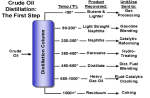
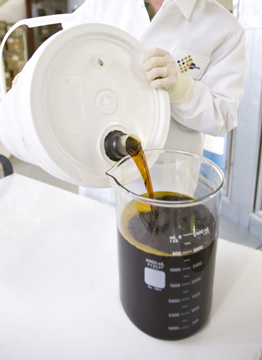
Purification involves separating chemicals in a mixture based their properties, primarily size, density, and phase (solids versus liquids ) Most “chemicals” are actually mixtures of similar but slightly different invididual chemical compounds, fior example natural gas is a mixture of methane, ethane, propane, butane, and pentane all derived from petroleum (crude oil), which consists of a mixture of tens of tens of thousands of different individual chemical compounds (see pic 49)
The Body: Our Chemical Machines-part II

In 1977 my father came home early from work one day and caught me watching cartoons on television. In a soft, but kind of scary voice, he informed me that I would be doing something after school from then on: soccer, swimming, or anything else, but I would not be coming home and watching television after school. So the next day I joined the (City of) North Miami Swimming Team, the Neptunes-pic51, and from then on spent every day after school swimming back and forth, over and over (and over) again.
While I don’t remember learning how to swim, in Miami we were always in the water: boating, spearfishing, waterskiing, and scuba diving. Some of my earliest memories are of spearfishing with my father when the spare spear I carried for him was as long as I was, and I dreamed of the day I could pull back the rubber surgical tubing of the Hawaiin sling and launch sprung steel spear with lethal effect myself, but until that day, I had to keep my father’s undulating rubber fins always in sight (through glass, and later polycarbonate facemasks), because there were dangers out there, and monsters like barracuda. and the sharks which ignored us as long as we never chummed the water around them (dog will hunt).
My father was also the ‘swim’ coach (Swimming,and starting in 1976, the newly sanctioned sport of water polo) at the inner city high school I would attended, Miami Central Senior High. He was transferred from the ‘all white’ North Miami Senior in 1971 due to desegregation, and fortunately, we lived right in between these two schools in an area of Miami inundated with rock pits#01, where every neighborhood had its own little lake, and swimming ability mattered far more than skin color.
Our lake was Twin Lakes on NW 135 st and 17th ave, and across the street, before being closed down and filled in(also around 1971), was the YMCA swimming pool where my father had been coaching North Miami’s swimming team. While I can just remember that pool, Twin lakes was always a center for our community, not only where my father taught me how to water skiing in our portable, outboard motor boat, and where my friends and I used to play “kill the man with the ball” on the narrow shelf of rock around the rim of the lake with a barrier of scratchy, and kind of scary, seaweed growing up from depths of the pit, and ‘out of bounds’ in our games; games. Later, with my father’s coaching, we would play for the state championship of Florida in the relatively new sport of water polo in 1981 and 1982, although we lost both times to the undefeated Ransom Everglades, a private school with all the advantages, including their own swimming pool right on campus. Ransom’s pool had a sign which read “Welcome to our ool, there is no ‘P’ in our ool, please keep it that way”. Competitive swimming and water polo were made possible through chemistry and the disinfecting properties of chlorine dissolved in the water, in certain amounts, or concentration: not too much, and not too little, it has to be just right!
The Supernatural, or “Not Chemistry”
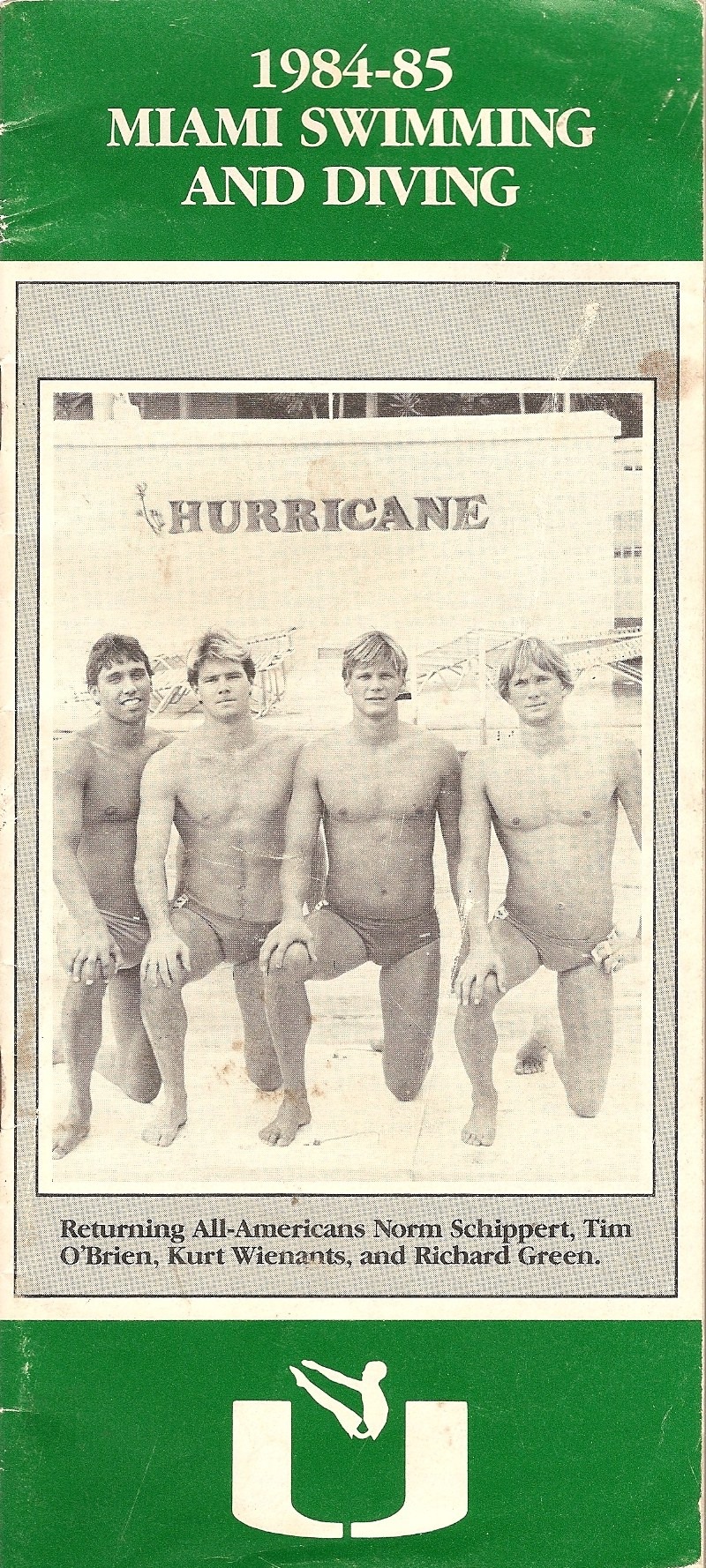
By 1983 all that swimming paid off when I was offered a swimming scholarship to the University of Miami to continue my study of chemistry(digging deeper). In 1986, after my coach, Bill Diaz (RIP) retired, I transferred to the University of Florida in the hope of making it to the Olympics in 1988 swimming for coach Randy Reese. Although I did not have what it takes to make it to the Olympics, coach Reese gave me an additional incredible opportunity, to learn more chemistry, firsthand, from Dr. Robert Cade, the creator of Gatorade, who began testing his new product, Gator Go, on the UF swim team, a product designed and formulated (a mixture of chemicals) to give the body what it’s hungry for: chemical nutrients.
The objective of Dr Cade’s research was to demonstrate the effectiveness of nutrient on the UF swim team, as he had demonstrated the effectiveness of electrolytes on the UF football team. During our workouts, our blood was sampled with pinprick analyzers to test for the chemical lactic acid(among others). Lactic acid is thought to be behind the pain of “no pain, no gain’, and the amount of lactic acid (concentration) in the blood is an indicator (like a canary in a coal mine) of how quickly our bodies were recovering from our workouts the ‘Recovery Time’, and less is better.
For Dr. Cade’s research, the body is just a chemical machine, and like a car’s engine, the type of fuel being used in that machine matters: premium versus regular, (determined by the fuel’s ‘octane rating;’ using the chemical octane, to indicate fuel quality), and as they say with computers, ‘garbage in, garbage out’. The body needs energy and building materials, but ‘supplements’ are not a substitute for a proper diet: ‘eat your vegetables’ is ancient wisdom based on millions of years of biochemical, co-evolution. Being part of Dr Cade’s research also helped reinforce lessons I learning in a class called Quantitative Chemical Analysis, or as I used to call it, “how to wash dishes properly” as cross contamination will ruins the results of tests for things like lactic acid, or octane.
Dr Cade’s research also taught me more about the Placebo Effect, which I first heard about from the TV show called MASH. I the show, when the pain killers run out, they resort to sugar pills, or placebos, to alleviate the pain. According to the chemistry, sugar does not alleviate pain, or “block pain receptors”, but placebos do work (at least sometimes, see probability), despite the chemistry, the only explanation being ‘mind over matter’, or the supernatural.
At UM, Coach Diaz used to always tell us “gotta believe”. He didn’t mean ‘wishful thinking’, he meant the miraculous power of determination, or, as Eminem put it, “you can do anything you put your mind to, man”, but you actually have to put your mind, and body(no pain no gain), and time into it: determination. Coach Reese once put it very different while yelling at out at us across the pool, “do you think God is going to wave his hand over your little heads and make you swim faster?” DIY: do it yourself.
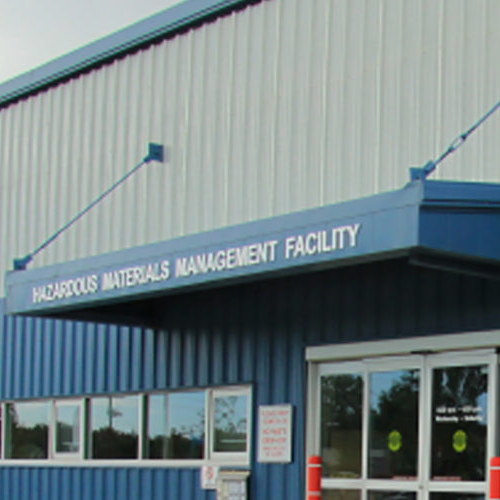
While I didn’t make it to the Olympics, as the Jimmy Buffet song says “the pleasure was worth all the pain”. Dedication earned me a lifetime’s worth of good memories and great friends, as well as a degree in chemistry from the University of Florida. My degree lead me to an amazing career in chemical management, with the opportunity to work as some incredible manufacturing facilities exemplified by Lockeed Martin Space Systems, as well as, help design Boulder County’s new (in 2010) Hazardous Materials Management Facility (HMMF) see BC.gov pic45.
end notes
01= rock pits. To extract, or dig out, all the limestone needed to build a city in the swamp, the 300 foot or deeper holes filled with water and became lakes (see book The Dade County Environmental Story by friends of the Everglades, 1987)
Part 3. My career
The Department of Environmental Resources Management: DERM
In 1989 I got my first career job working for Miami-Dade County as a Pollution Control Inspector. My main duty was educating about, and enforcing, the county’s Best Management Practices(BMPs) for industrial chemicals. My other duty was searching across the county for leaking underground storage tanks(LUSTs), the result of not storing motor fuels (chemicals) in the proper container; in this case, using steel tanks which began to rust when buried underground in a city built on a swamp(thanks to limestone from the rock pits). For decades, these tanks sat underground, unobserved (out of sight, out of mind), rusting away until little holes began to form, and motor fuel began leaking into Miami’s precious drinking water supply”: the Biscayne Aquifer. When this fuel began showing up at Miami-Dade County’s water pumping stations, new regulations and laws were quickly enacted to get these tanks removed and any leaked fuel cleaned up(remediation) which was my job was to officially witness and verify the cleanup process was being executed.
After watching my first LUST ripped out of the ground by a giant track hoe, and seeing the old nasty motor fuel leaking out into Miami’s precious drinking, I needed an escape, and found it on a television program called ‘Your Organic Garden with Jeff Cox’, where Mr Cox explained, and demonstrated, how to use common, household “chemicals”, to create my own little paradise in the back yard; a place to escape “the real world”.
Ironically, at work, Miami-Dade County was evaluating a new process for cleaning up fuel spills called bioremediation, and this process was startlingly similar to what Mr Cox was teaching me on TV,: nurturing mother nature in order to do useful stuff, like growing food, or creating wildlife habitat, or removing pollutants. In the late 1970s Jimmy Carter(RIP) helped pioneer this process by starting the Aquatic Species Program, designed to seek out (aquatic) organisms which could be harvested and processed into motor fuel. Today organisms like algae can be grown to treat factory exhaust, removing CO2 and other “pollutants”, and processes into more fuel for the factorypic36 (*cataytic cracking is technology developed for refining petroleum, and can be used to produce useful chemicals such as bioplatics, jet fuel, and engine lubricants (see pic48 ‘Green Crude: also Biofuelsdigest.com)
The Electron Beam Research Facility; “the beam”
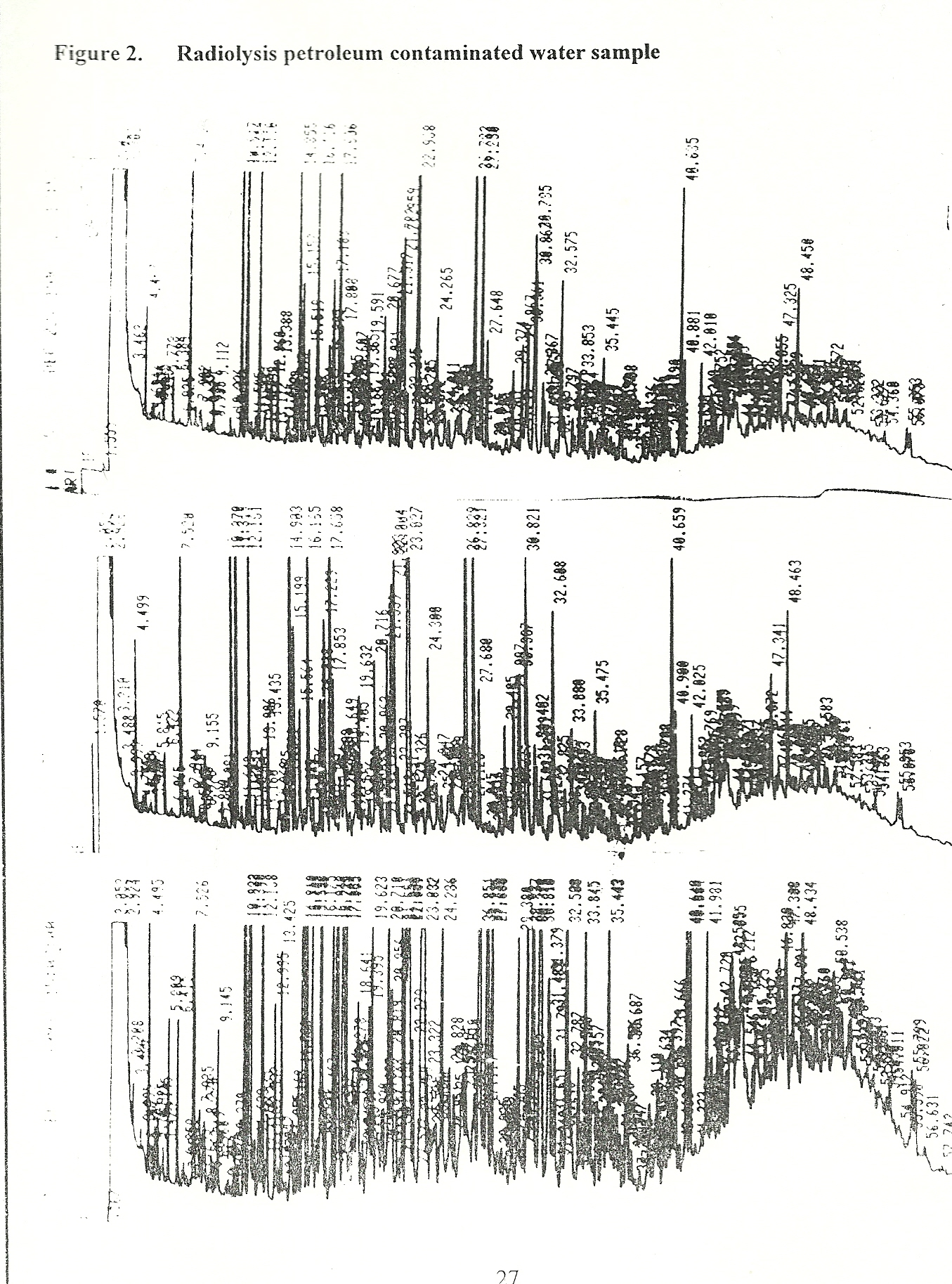
In 1993, I returned to school for a master’s degree in chemistry from Florida International University to study the destruction and removal of hazardous chemicals from water using the world’s first horizontal electron beam. “The beam” was originally built by Miami-Dade County in order to disinfect “waste water”aka sewage, during emergencies (hurricanes), and my professor, Dr William Cooper, had repurposed the beam to destroy hazardous chemicals- a process similar to incineration, but without having to remove the chemicals from the water first. I wanted to see how the beam worked on motor fuel, but quickly learned that, like everything else, it’s not that easy; motor fuel is made from petroleum, and petroleum is made of (tens of) thousands of different, but similar, individual chemicals(see my GC of diesel fuel pic47 ). So I ended up choosing just one of the many chemicals in petroleum, naphthalene(also used for moth balls). In the end, I discovered that it is much, much better to just not pollute in the first place, as they said at DERM: pollution prevention through waste reduction (waste in a verb, not a noun); it costs a lot of money (and equipment) to generate the 1.5 million volts needed to generate an election beam; and fuel chemicals should be used for fuel; if they are being managed properly.
Miami Beach Senior High School
Everything has benefits as well as risks, and this was demonstrated to me in grad-school with the new world wide web, or internet: it gave me access to all kinds of research on radiation chemistry, but also access to all the various job possibilities available all over the country including a job I really wanted in Colorado at Boulder County’s Household Hazardous Waste Facility- where I could imagine all the cool stuff they must get to see there (like the old carbide headlamps used in mining before electric headlamps were available). The risks of the internet were also demonstrated to me: computer viruses, which deleted my thesis paper, and made me have to write it all over again, and miss the chance to graduate on time and not be able to interview for the job I wanted.
Fortunately, my step mother who was the science department head at Miami Beach told me they needed a new chemistry teacher, and helped me get a job. While teaching was not my first choice, I was pleasantly surprised at how interested my students were at learning basically the same thing I had been teaching to businesses as and inspector for Miami-Dade County: chemical Safety, which was basically the same thing as I had learned in high school. While having such wonderful students did encourage me to want to make a career of teaching chemistry, after the attack on the world- trade center on 911, I needed to get back to the mountains, and decided to move out to Boulder and wait for a new opening for the job I had seen in gad school.
The Hazardous Materials Management Facility, HMMF
In 2005 I fiinaly got that job at Boulder Country, I had been waiting for, working as a hazardous materials specialist, and becoming a certified hazardous materials manager (CHMM) supervising the collection of Household Hazardous Waste(HHW) from Boulder County residents. Garbage collection in Boulder County was performed by a private company, Western services, and they had begun to forbid the disposal of certain chemicals, particularly liquids, in with the “regular trash”- a policy prompted by costly accidents. including having their garbage trucks catch on fire due to these chemicals in the trash, or dripping paint (or worse) down the road.
In response, Boulder County opened a temporary HHW collection facility at Western Services’ Trash Transfer facility, although their site was quickly becoming overwhelmed by the amount of material being collected, particularly oil based paint which is both flammable and toxic. Building a new, permanent, facility was made possible by the dedication, and commitment of a county commissioner, Graham Billingsly, who pushed the county commission to fund a new (in 2010), collection site, the Hazardous Materials Management Facility(HMMF- see pic). Boulder county was helping lead the way in resource conservation, aka, chemical management, working toward a policy of Zero Waste, working in concert with private companies like Western Services which was pioneering programs like composting of kitchen scraps, and yard “waste”, along with small companies recycling building materials, and unused paint.(see Ecocycle, and Resource) see Bouldercounty.gov).
Lockeed Martin Space Systems.
In 2012, I began working for a company Clean Harbors Environmental Services, as a Clean Pack Chemist, and had the opportunity to manage chemicals at some incredibly fascinating manufacturing facilities like Lockeed Martin Space Systems in Littleton, CO, and Halliburton Energy Services in Casper Wyoming. The most fascinating being Lockeed-Martin, which had repurposed its manufacturing facility from producing Intercontinental Ballistic Missiles (ICBMs) to Global Position Satellite (GPS) (better living). On my first day my colleague and trainer lead me into a cavernous central facility with an amazing array of fancy stuff on the ceiling like huge gantries and control rooms, when he grabbed my arm and said with a big smile face, “in this area you have to be very careful of the giant hole in the floor” (where they had assembled ICBMs)
My main duty at CHESi was packaging and transporting hazardous materials from various industrial sites around Colorado and Wyoming to their central processing hub in Denver, which included the Climax Molybdium mine in Leadville, Colorado. Returning to Denver involved driving beneath one of my favorite spots on Earth, my little perch high above the road at the top of a ski run called Gautire (see pic) at Arapaho Basin ski area which is on highway US 6, and the only route permissable for hazardous materials crossing the continental divide. (see pic, no hazmat in tunnel??). For me A-basin is as close to backcountry skiing as possible at a ski area, and where I could enjoy the sublime calling of mother nature, along with some very intense skiing; proof that Mother nature and industry can thrive side by side, with the proper management (and teamwork), which makes anything is possible; as Captain Piccaard said on Star Trek, “Everything is impossible, until it’s not”.
Juxtaposition II
While in graduate school I lived in an area of Miami called Little Haitti, on an inner city farm which was three blocks from Miami’s main prostitute road, 79th street. Inside the tall wooden fence surrounding the block of houses the owner rented out, was a tropical paradise, with the backyards of the houses creating a little farm with goats and bees and gardens, where local teachers brought school children on field trips to see a real live farm, and a place where they could see where food actually comes from, which is not the grocery store. Outside the fence was Miami Vice, but inside was paradise, resulting, as Joni Mitchel explained: “pave paradise and put up a parking lot”, when everything is paved problems result, like ghettos, but with the proper management paradise can be restored, not with top down, one size fits all management, but a bottom up management system which in begins with We the People, working together, cooperatively, to create a better world, a modern day ‘Garden of Eden’ where we all live in paradise; better living through chemistry.


58-60
Filed under: Uncategorized
Everything that happens follows Gaussian distribution, or the bell curve: from the test grades of students to what happens in life: good days, and bad days, but most days are average (the 99%), and it is the average that matters, because only the average can be changed, or managed, while the extremes are inevitable: shit happens, as the Bible in Ecclesiastes 9:11 (yes, 911): time and chance happeneth to them all”.
No one understands ‘time and chance’ better than the gambling industry, and they have raked in the profits by understand the bell curve; they actually call it the Monte-Carlo technique, which allows them to control “the average”, and make lots of money while keeping the customers, coming back for more, with their belief that next time they’ll hit the jackpot. There is no control of the extremes, but the average can be controlled (time management), studying for the tests, brushing your teeth, eating your vegetables, exercising, hugging your kid, or wearing a smile, because smiles are contagious, but so are frowns; as the group Public Enemy says, “Don’t let a win go to your head, or a loss go to your heart”.

Filed under: Uncategorized
I started my first garden in 1990. It was not about growing all my own food (which would be nice if it were possible), but it was about creating my own little paradise in the backyard, and a place to escape “the real world”. At the time, I was working as a pollution control inspector for Miami-Dade County, and my job was to witness (literally) some of the ugly stuff going on. The idea for creating a garden came from a television program called ‘Your Organic Garden with Jeff Coxx’,and Mr Coxx was showing me exactly how to create that paradise using common, household items.
The most important part of any garden is the soil, or “top soil”. The garden soil is like a pet, and needs to be taken care of, or nurtured; given the basics of water, food, and shelter, and TLC, or tender loving Care, is also very helpful. Fertile soil is the key to gardening; growing plants without soil is hydroponics, and hydroponics requires lots of expensive chemical nutrients. For me, gardening is not about growing food, but creating ‘wildlife habitat’, where creatures who have lost there homes due to development, can build new homes and thrive while encouraging some, and discouraging others (pulling weeds; the alternative is a world filled with weeds, rats and roaches; ‘pests’ which are being unintentionally nurtured, by not nurturing beneficial organisms like ladybugs, dragon flies and birds.
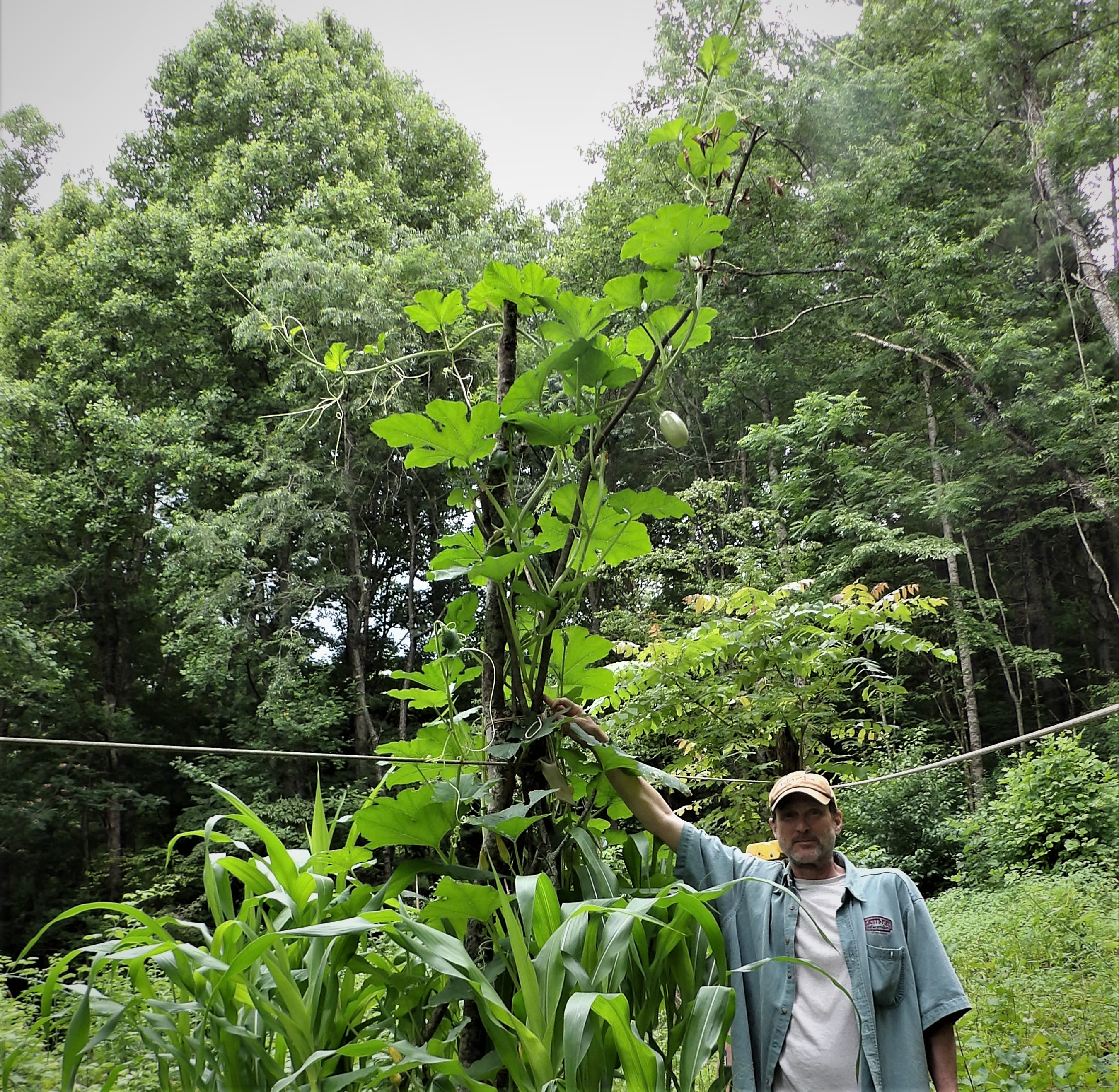
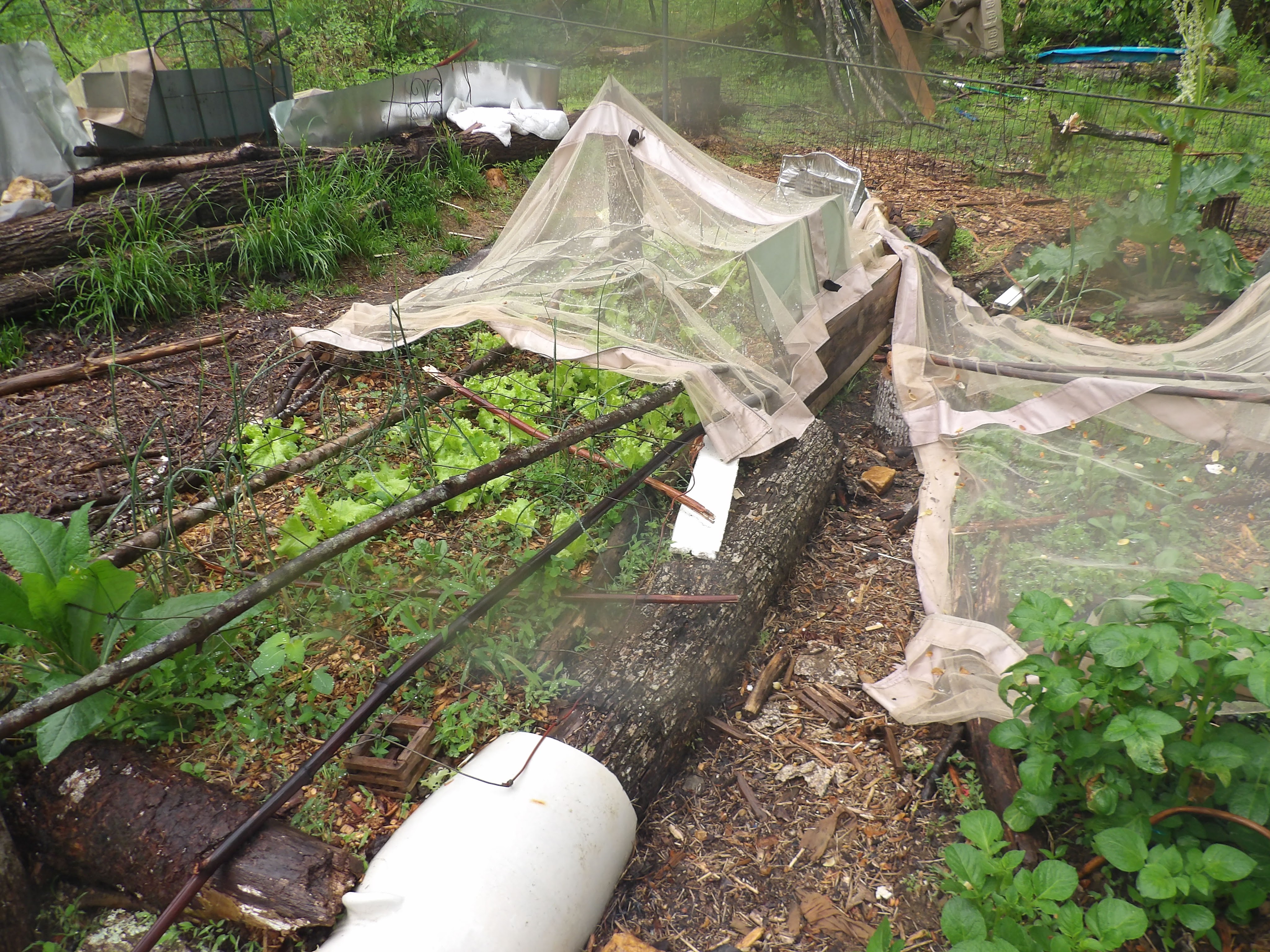
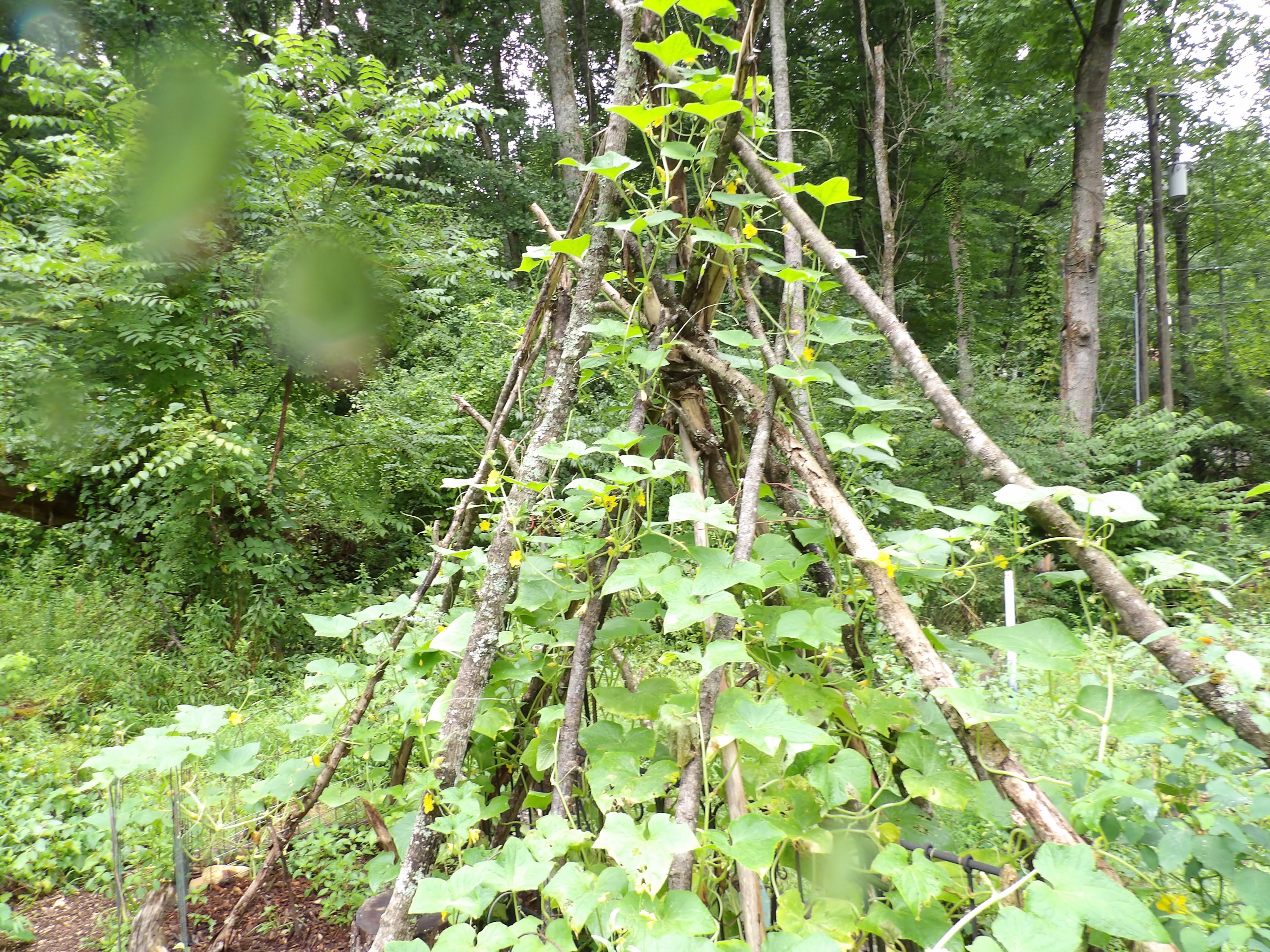
Woodshavings: one mans trash is another man’s treasure
In 2016 I found some treasure. A huge trove of woodchips nearby, on a little country road, about two miles from my house, where a local tree trimming company was dumping the wood chips they produced cutting down, and disposing of, the trees they cut down with their industrial sized wood chipper. I contacted the owner who told me I could take all I wanted, as the wood chips were disposal problem, and cost, for him. I have lived in places where wood chips where a valuable a commodity, an sold as mulch to help protect the soil from erosion from wind and rain, as well as providing shade(intense UV radiation causes sunburns, but is also harmful to soil microorganisms involved in the ‘composting process’
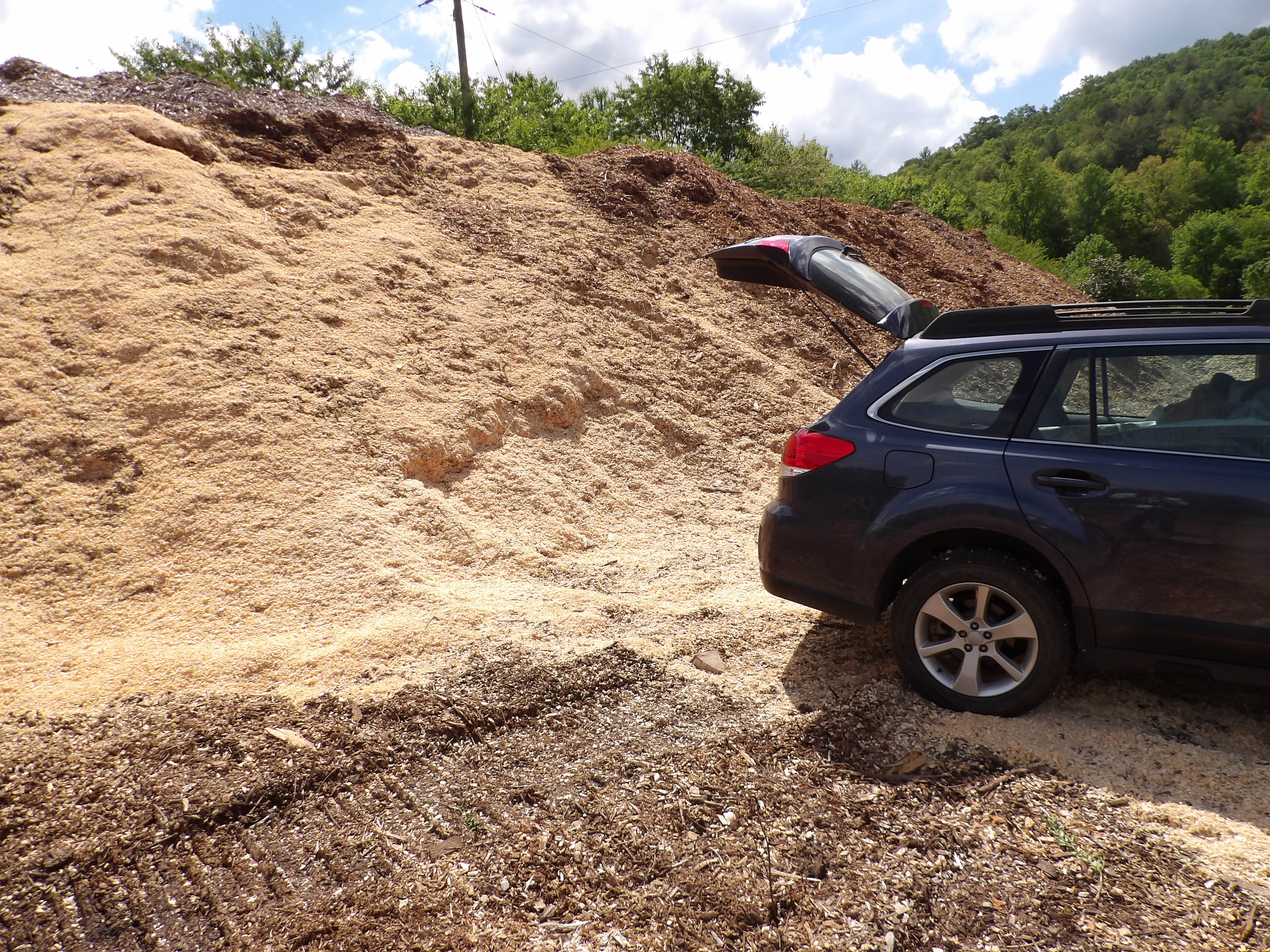
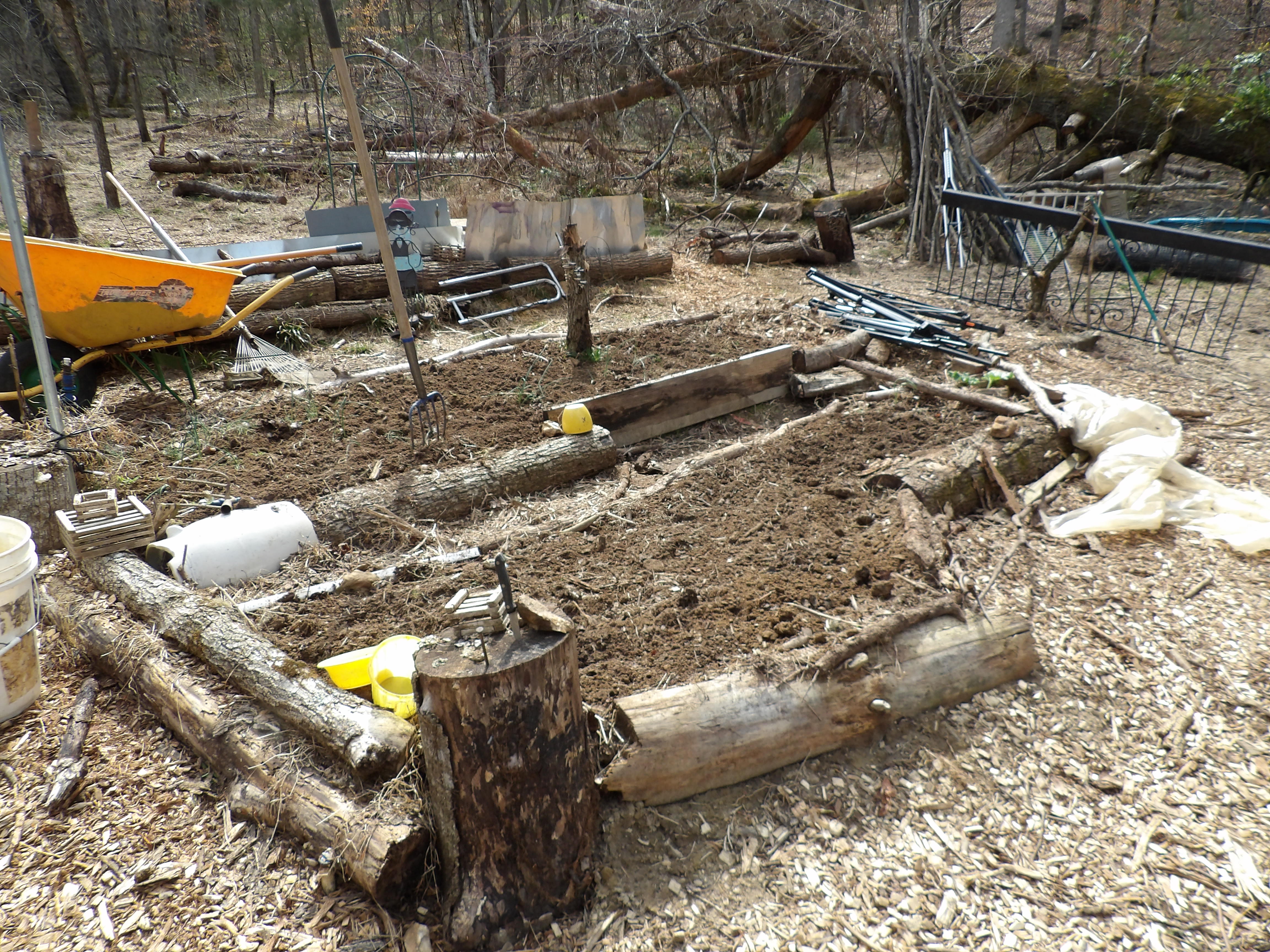
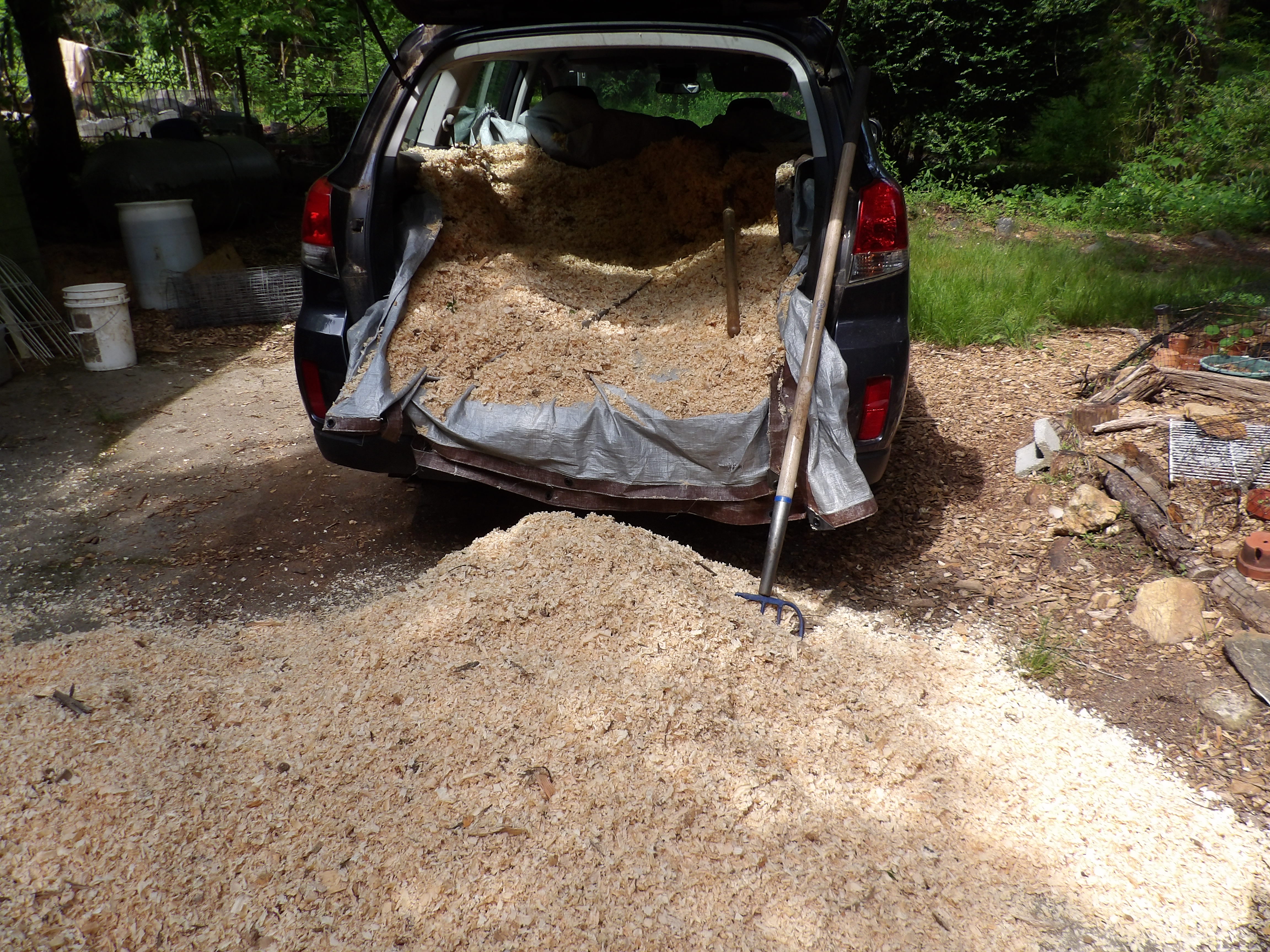

My house is on the north slope of a hill, and the gentle slope makes he erosion problem worse, so there is a greater need for protecting the soil from washing away. For years I would hike over to he site to see what kind of chips they had making me ‘chip rich’, with a choice of wood chips from oak, black walnut, and pine. The owner had also told me once the best chips come out right after the blades on the chipper have sharpened, which makes the chips come out smaller and more uniform in size. One day they had something better than wood chips, they had wood shavings. I don’t know where they came from, but I got four car loads of wood shavings are thin, curled up, ribbons of wood which are very light and “fluffy” (low density), and perfect for mulching around tender, newly sprouted, plants which are easily damaged (and killed) by larger and heavier wood chips.
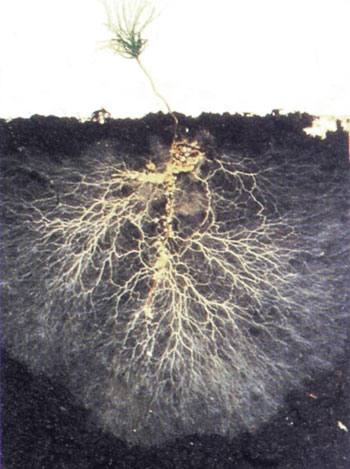
The value of mulching is that mulch not only protects the soil from being lost (wind and rain erossion), but also become more top soil over time in the ‘composting process’. Woody materials (chemicals like primarily cellulose and lignin), are transformed by a ‘biological process’ into more ‘top soil’, and more soil means better plant growth. Top soil is similar to an ocean reef where there is a solid (non-living) structure with lots (and lots) of organisms living on, and in, that structure. The root hairs of plants (see pic) also inhabit this structure, and the roots themselves exude certain nutrients which help boost the growth of microorganisms(like gardening) which provide the plant with the nutrients it needs
‘Bare soil’ does not exist in nature, the ground is always covered with leaves, twigs and other ‘woody materials’ which are the direct products of photosynthesis, aka ‘primary production’. These woody materials, aka mulch, provide the protection and insulation to help keep the soil underneath healthy. Protecting the soil from drying out and blowing away in the wind, or ultraviolet radiation damage during the harsh noonday sun; turning the soil into dirt, and the dirt gets eroded away by the wind or rain.
The only problem with using mulch brought in from elsewhere (like the store) is that the composting process uses lots of nitrogen from the soil and must be replenished by fertilizers, or the plants will suffer from nitrogen deficiencies(“plants eat at the second table”, after the microorganisms). This process uses a lot of nitrogen, which must be replaced and urine is an excellent source of nitrogen. Urine is a natural fertilizer which can be used to recycle two “wastes” (urine and yard waste) into one valuable commodity: Top soil. * Urine should always be diluted at least 3 parts water to 1 part urine- tiny amounts of sugar can also help provide an energy boost for microorganisms involved in the composting process.

The last pic is of my new favorite tool, the hunting knife. The big blade (should) slip down easily into the soil and indicate how ‘tight’ the soil is according to how hard it is to insert the blade; tight soil makes it harder(or impossible) for air (oxygen) and water to penetrate down to the plant’s roots; the wide sturdy blade can break up, and pry up, compacted soil to and allow oxygen and water to enter.(what good is food without oxygen and water?)
Filed under: Uncategorized

Pyramids of garbage saying “fuck you” to future generations
Where’s your shopping bag?
Filed under: Uncategorized
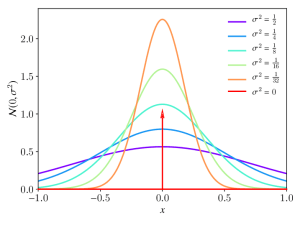
Life is a bell curve; a normal distribution of events where most of the stuff that happens is “average”, and average is by far the most important part of the Gaussian Distribution. The Bible explains how “time and chance happeneth to them all” (Ecc 9:11), but sometimes, no matter what you do, “shit happens”, but as the rap group Public Enemy said, “don’t let a win go to your head or a loss go to your heart” (stay the course).
IN the modern world of instantaneous communication we have developed a very bad habit of focusing on the extremes; the average is boring, and nobody wants to eat their vegetables, they want fast food and high tech multivitamins. The media exacerbate the problem with their sexy, subliminal commercials and news stories based on “if it bleeds it leads”. Good Samaritans, and good work(s) are boring, and politics has become about finding a God-like leader who can lead us to the promised land with a huge supply of magic pills.
It is very large world we live in, and there is more and more shit happening every day, it is unavoidable, the second law of thermodynamics; entropy is deliberately creating chaos and disorder, but when we are not buried in shit, it is up to each of us to elevate our own 99%; “get wisdom, and with all thy getting get understanding” (proverbs 4:7), as well as practicing something (whatever your something is) practice makes perfect, but practice is boring until you become a rock star, but you can’t become a rock star unless you practice.
Filed under: Uncategorized
My First harvest of raspberries. Got about 2 pints to start with, last year I got about ten pints total and my patch has doubled in size, so hopefully I’ll get a bumper crop this year with twice as many… maybe even more 😉

My friends at the farmers market offered to sell them for me, but it’s not even close to worth it for me; simply the labor of picking them (not to mention caring for them all year), would not be enough for me to afford store bought raspberries, much less MY raspberries. So thank a farmer next time you go to the farmers market for they are growing you amazing food for practically nothing. My raspberries are about to become raspberry pancakes, raspberry cookies, and raspberry cobbler, bon apatite.
Filed under: Uncategorized

We are descended from an ancient civilization which built giant megalithic structures that still defy our understanding today (muon detectors find hidden chambers within the great pyramid we still can’t access). The ancients did not excavate and haul around giant rocks for the fun of it, they had a purpose, and I propose that purpose was gardening. In other words, using materials and technology to grow and nurture organisms which benefit us- see The Botany of Desire by Michael Pollan.
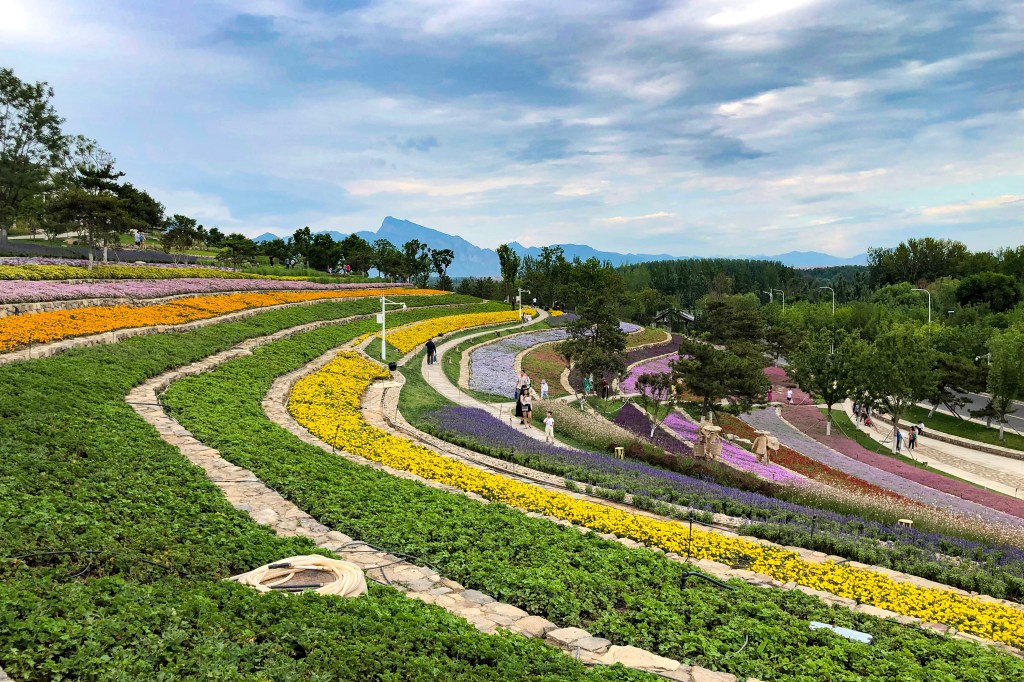
It looks to me as if entire mountains such as at Machu Picchu, were sculpted into colossal, south facing, gardens. These terraced, crystalline stadiums were probably landscaped with strikingly beautiful, and economically beneficial organisms such as lavender and rosemary grown in intricate patterns like the nasca lines. These colossal gardens could also have provided stunning vistas for sight seeing tourists orbiting the Earth on pyramid powered magic carpets Walt Disney style (its a small world after all)…Arthur C. Clark pointed out that any sufficiently advanced technology is indistinguishable from magic.
Biochemicals
The ancients could have harvested biomass at a tremendous rate, and using advanced nurturing techniques produced and over abundance of sugar cane and other sugary plants like beets to make (lots of) ethanol; olives and other oil rich plants along with algae and cyanobacteria to make biocrude(see pic) processes with advanced catalytic cracking techniques like those used by today’s petroleum industry, to produce an over abundance of chemical resources; the horn of plenty in a global Garden of Eded(see biofuelsdigest.com).

Grow your own
Gardens not only grow food and other useful resources like the Lufa sponge, they alslo provide a place to escape the real world while allowing each of us to help improve it a little bit- if everyone had a garden this would be a global Garden of Eden. My gardens have also been a place to try to reuse and repurpose materials (or places like buildings- see last pic), materials which would otherwise be “wasted” and sent to the landfill for future generations to deal with, the ancients did not leave megalithic landfills, they left megalithic planter boxes made for gardening the Earth.

KODAK Digital Still Camera

Filed under: Uncategorized
It’s spring again, and I want to appeal to everyone to please start gardening! Whether you have a large garden outdoors, or just a few potted herbs growing indoors, the plants you can grow contain hundreds of different nutrients, from the major nutrients we all know about, to minor nutrients we are still discovering. For instance, rosemary is reported to improve memory, and that means rosemary must contain some nutrient(s) which improves brain function; what those nutrients are, or how they work, is still unknown. Nutritious food is like high octane gasoline, and high test gas ‘cures’ engine knock by allowing the engine to work better, not by changing the way the engine works, and switching back to cheaper, low octane gas, causes the knocking to return.
I have been gardening for decades now, and the one thing I’ve learned is that you don’t need a green thumb to garden (I kill lots of plants every year), what you do need is a commitment to gardening, that is, to grow things. A garden is like having a pet, and what it needs from you is to provide water, food, and shelter, along with a little nurturing, so they can grow on their own. In the end, the cost of gardening is insignificant compared with the cost of getting sick(engine knock), and the best way to avoid getting sick is to get all the nutrients you can into your diet and allow your body’s own immune system to work better keeping you healthy. So please, please start gardening, gardening is like growing your own multi-vitamins which help keep you and your family healthy- and as far as nutrients go, more IS better.
Filed under: Uncategorized
2. chickens
When raising chickens in a suburban environment, there is a lot of effort involved in containing the chickens in order to prevent them from getting ‘loose’ and either run over by a car or caught by some stray dog or cat.
For a chicken the grass is always greener on the other side of the fence, and they have no ability to consider the risks associated with the other side of the fence- they are just chickens, and part of raising chickens is protecting them from the outside.
In a smilar way on June 12, 2012, an article entitled “Budget cuts strain efforts to fight large Western fires” By Barry Petersen in CBSNews.com explains how the budget cuts in less active years leads to shortages in the more active years (like 2012). One example is the number of planes available to help fight the fires: “There were 43 tankers a decade ago; now there are 17”.
It is reasonable to assume that society rewarded the person who ‘cut the budget’ by eliminating pork barrel projects such as the excessive number of tankers sitting around doing nothing when there are no fires.
Filed under: Uncategorized
Tax petroleum to build a Biofuel infrastructure before it is too late!
There are many making a big stink about greenhouse gas emissions (GHG) from Biofuels. The results of various studies indicate that the best biofuels may only emit some percentage(around 80%) of GHG s as compared with petroleum based fuels. The issue is that growing fuel is in no way comparable to mining that fuel (petroleum) out of the ground. Petroleum was formed by organisms that grew in ancient times, and burning the petroleum releases the carbon they absorbed back in ancient times and redistributes it into today’s atmosphere. The difference is that biofuels remove CO2 and other compounds from today’s environment, while they are growing, and it is irrelevant to consider what percentage of compounds are re-released into the atmosphere upon combustion. Burning or combusting any carbon based fuel will release carbon compounds into the environment, but biofuels are reusing ‘pollutant’ compounds where petroleum is releasing stored pollutants from millions of years ago.
Petroleum requires an infrastructure to extract, process and distribute to make fuel and other products, and this infrastucture has the advantage of having been built up for over 100 years. Biofuels also require an infrastructure to produce, process and distribute these materials (like algae) to make fuel and other compounds in a manner that is very similar to the processes used to process petroleum. While petroleum can be used to make many of the compounds we require in modern life, from asphalt to gasoline, the side effects of that production also creates many unintended consequences such as oil spills and ground water contamination. Additionally, extraction processes such as tertiary extraction(using solvents) and hydraulic cracking are used to remove petroleum from underground by injecting compounds (generally pollutants) into the ground in order to loosen them up for removal. However, increasingly there are more and more homeowners that have the ability to light their own tap water on fire, and what does that indicate about safety of the water they must drink? It is ironic that smoking comes with warning labels, but hydraulic cracking does not, yet!
The potential of Biofuels is also being denigrated by the food versus fuel debate, and more recently has been criticized as a ‘drinking versus driving’ debate. Biofuel feedstocks are being attributed to causing ground water contamination, specifically because of nitrate fertilizers used to promote growth; though this problem did not caused as much uproar where food agriculture is concerned. However, water contamination from fertilizers, weather from agriculture or biofuel production is a management issue, not a process issue; though asking our bean counting leaders to manage something properly may be too unrealistic.
Discounting the nattering of professional politicians who are desperate to keep their jobs, biofuels must be developed to ensure the future survival of humanity(how can we survive when all of our drinking water becomes flammable?). We must demand that this process be developed fully, and on an emergency basis much like the Manhattan project. Left on their own politicians will ‘debate’ this issue until it is too late, and our society is past the point of no return (you can’t start producing biofuel once the petroleum has run out, nor avert a financial crisis by listening to those stealing the money).
Companies like Genesis Biofuels, Origin Oil, and Gevo (among others) are generating biofuels by treating wastes such as the emissions from Power Plants, Cement Plants and even Pine Beetle infestations. These type projects are critical for many reasons, including reusing the CO2 generated by power generation, and using it to generate more fuel rather than simply allowing it to become a pollutant. Cogeneration has become a standard industrial practice today, and it began through a concerted effort to reduce waste; both economically and environmentally. The ‘waste’ now has become not reusing the CO2 generated, and it is much like throwing the ‘baby out with the bathwater’.
For now the only real issue is generating the money that this new infrastructure will require; money that is an investment in the future and not some ‘pork barrel’ spending program that will never realize any returns. Generating fuel produces a necessary commodity, and can be produced locally to provide not only small scale economic benefits, but also benefits for the entire planet, as well as the future of the human race. There is only one logical source for funding and development of the infrastructure for biofuel, and that is utilizing the current energy infrastructure created by the oil industry. Gasoline taxes are never popular (nor are any other taxes), but this extremely large industry is one of the few remaing sectors that has the ability to generate money. Gas taxes dedicated to biofuel production are an investment in the future, and our leaders need to stop being subservient to the financial industry and their clever ideas on ‘derivatives’ and other forms of generating money without producing anything (like moving their manufacturing to China in order to make more money).
We need to start demanding action from our leaders, if not, they will continue to have arguments full of sound and fury that signify nothing. A tax on fuel can be easily added to existing fuel taxes, and could be designed to avoid increasing shipping costs by not raising the tax on diesel fuel. Those of us who can afford to drive everywhere can also afford to pay a little more for that luxury, and we would know that we are helping to pave the way to the future.
 Greenenvironmental's Blog